Published 2026-11-10 · VWU.AI
After the Cosmos Update: Organizing and Accepting World-Model Training Data
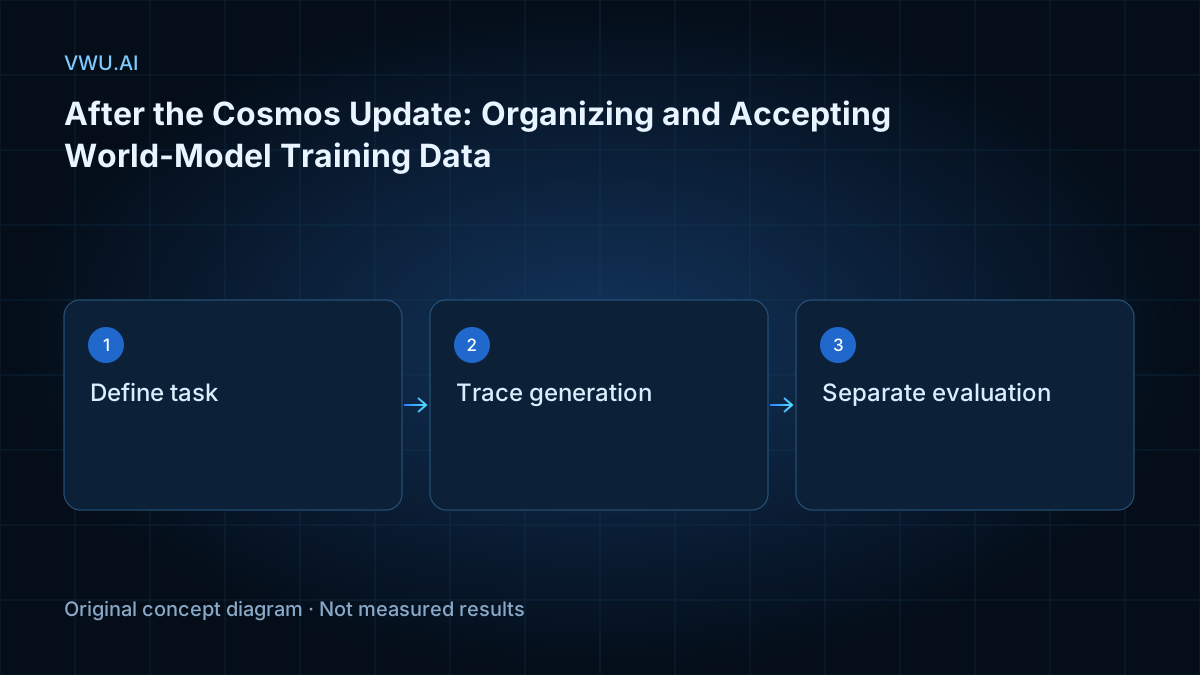
A practical world-model data plan following recent NVIDIA Cosmos updates: task intent, real-world anchors, generation conditions, label versions and independent evaluation, with a delivery checklist and in-cabin examples.
In its October 21, 2026 announcement, NVIDIA introduced Cosmos training tools, simulation checkpoints and Data Factory blueprints, including weather and lighting variation and rare-event generation. These tool descriptions do not establish that any generated video is immediately suitable for training.
Even when a world model generates or predicts visual changes, the data team still needs to answer a specific question: which task does each delivered clip support, and what evidence justifies accepting it? The following engineering recommendations draw on public information; they are not NVIDIA implementation instructions.
Key recommendations
- Define a testable learning task before deciding which videos to generate.
- Use real-world anchors to constrain generation, and retain source, parameter and label-change records.
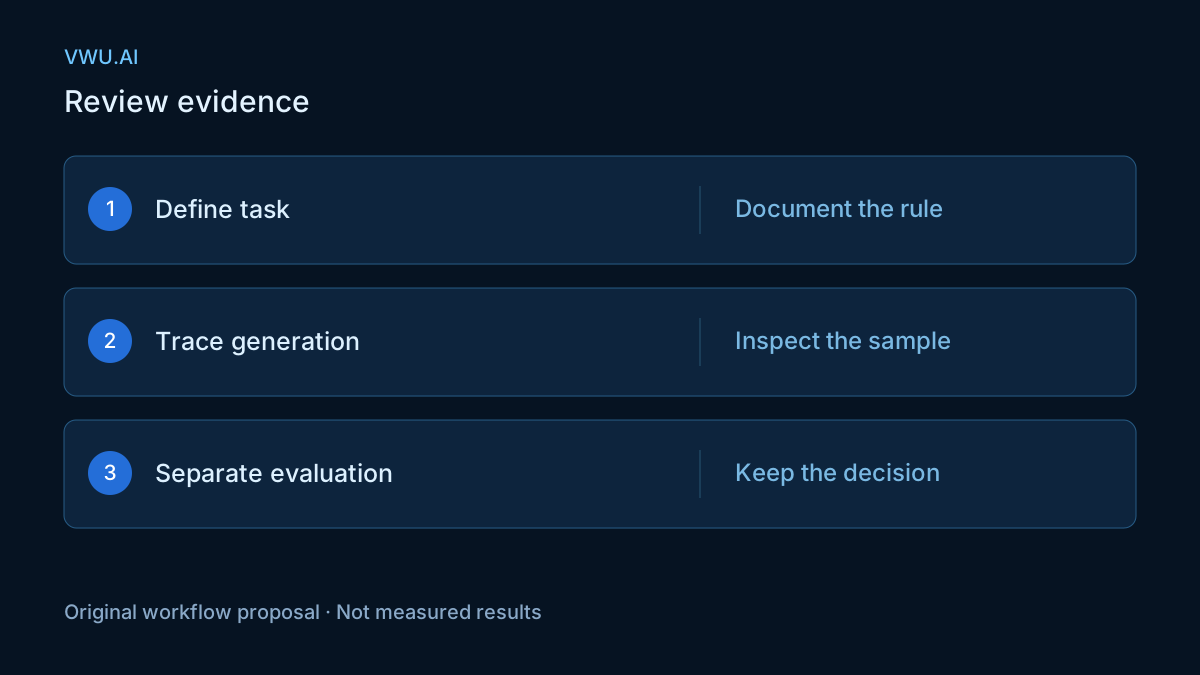
- Delivery acceptance establishes usable material; independent real-world evaluation tests model benefit. Keep the two decisions separate.
1. Replace clip counts with a task recipe
Here, a data recipe is a working term for records that explain purpose and reconstruction: task intent, a real-world anchor, generation conditions, label rules, version relationships and evaluation evidence. It is not a fixed platform file format.
For example, requesting more driver head-turn videos is insufficient. A head turn may support head-pose estimation, gaze-zone classification or behavior-event recognition. These tasks require different facial visibility, temporal continuity and label detail. An order that says only head turning invites confusion between plausible appearance and task suitability.
Start with a task statement: the input is continuous footage from a fixed cabin camera; the output is a predefined head-orientation class. Accept clips only when agreed facial regions are sufficiently visible, and use an unobservable state under severe occlusion. Refine scope using the driver-monitoring overview instead of merging every cabin behavior into one class.
Driver monitoring data overview
Task intent — Record model input, expected output, included and excluded uses. Without it, the same clip can receive conflicting purposes.
Real-world anchor — Record source batch, usage basis, camera and scene conditions. Without it, generated output cannot be related to actual conditions.
Generation conditions — Record model version, prompt, seed, controls and post-processing. Without them, failed samples cannot be traced or reconstructed.
Label rules — Record class definitions, time units, visibility and unobservable conditions. Without them, annotators must rely on impression.
Version relationships — Record original and derived clips, label versions and split relationships. Without them, related data can cross evaluation boundaries unnoticed.
Evaluation evidence — Record a fixed baseline, real-world test subsets and failure lists. Without it, file delivery can be misreported as performance improvement.
2. Use anchors for meaning and conditions for change
An anchor is more than a reference image. It should describe viewpoint, scene arrangement, visible regions and permitted use. If permission covers only a specific development use, check whether generated derivatives are included; generated appearance does not automatically permit redistribution.
For cabin tasks, distinguish permitted changes from properties that must remain fixed. Lighting style or background appearance may vary; driver seat, camera position and action order may need to stay fixed. The task determines these decisions; one list does not fit every model.
To expand one action across lighting conditions, keep motion and camera fixed while varying lighting first. Reviewers can then check for unintended extra head movements. Changing camera, person, clothing and light together makes any model difference difficult to attribute. This is an experiment-design recommendation, not a measurement of Cosmos consistency.
3. A hypothetical reviewable head-turn delivery unit
The following illustrates record design, not real customer data or validated product capability. Project participants should define their own field names and values.
recipe_id: cabin-head-orientation-demo-v1
task: head-orientation classification
source_group: authorized-session-A
parent_clip: source-A-clip-014
allowed_change: lighting appearance
preserve: camera, driver seat and action order
label_rule: head-orientation-rule-v1
uncertain_policy: unobservable when required facial regions are hidden
split_group: source-session-A
acceptance_owner: project-designated reviewer
Do not simply copy parent labels after generation. Check whether posture changes, the face disappears or action boundaries shift. Whenever generation changes task-relevant facts, inherited labels need review. If event timing changes, use the temporal-boundary guide to define reinspection.
In-cabin temporal annotation boundaries
A delivery unit should include video, labels, recipe records and review decisions. A reviewer should trace video to labels and labels to the source. A complete archive establishes material completeness, not semantic correctness.
4. Accept material before running model experiments
First exclude inputs the training pipeline cannot consume, then perform more expensive semantic review. Use the following order and retain the rejection reason at each stage.
1. Files and decoding: verify IDs, hashes, resolution, duration, timestamps and label references; inspect opening, closing and key intermediate frames even after decoding succeeds. 2. Condition preservation: turn fixed properties into observable checks for camera, seating and action order. 3. Label consistency: independently review footage and labels, especially occlusion, unknown intervals and boundaries; retain disputes rather than erasing uncertainty with a majority vote. 4. Relationships and splits: link original, derived and near-duplicate clips, isolating project-defined source groups; consult the leakage audit. 5. Intended use: identify training, development or pending-review samples. Do not add unverified generated clips to a real-world final test and continue calling its results real-world evidence.
Do not copy acceptance tolerances from industry rumors. Timing tolerance depends on task scale, frame rate and downstream decisions. Calibrate it together using disputed pilot clips, then record it in the contract or acceptance specification.
5. Use independent real-world tests to decide scale
After material passes acceptance, compare a fixed-setting baseline with the added-data approach. Keep the real-world test set, metric definitions and training budget comparable, and report important subsets rather than just an average.
For head orientation, subsets might include a clear face, partial occlusion, borderline poses and camera views. Report usable and unobservable counts in each. If independent examples are insufficient, state insufficient evidence instead of claiming coverage.
Agree three decision paths: scale only when the target subset benefits without unacceptable regression on important conditions; investigate source and experimental settings when results are unstable; return to generation and labeling when task meaning is wrong. Define unacceptable regression in advance, not after seeing results.
6. Request a small, traceable sample package first
Tool updates make new production approaches worth investigating, but purchasing decisions still need reviewable samples. Ask a supplier to demonstrate the chain from source basis through generation records and label review to experiment use, with failed examples and limitations.
If only attractive demonstrations are available, clarify source relationships and task conditions before ordering. A data recipe helps development, procurement and review teams discuss the same questions: what decisions the data supports, where evidence lives and which record traces a failure.