
Driver Drowsiness Datasets: Define Labels Before You Buy
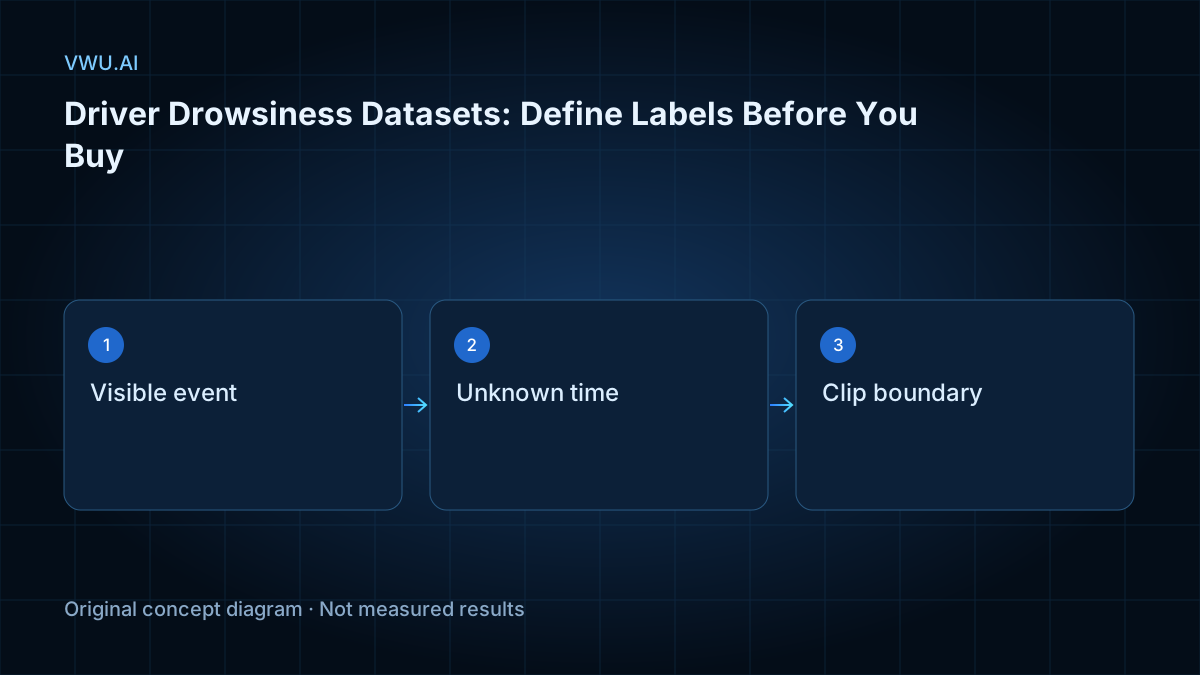
A driver drowsiness dataset should come with a clear account of what its labels mean, how those labels were obtained, and which time interval each label describes. Start there before comparing video counts. A clip showing closed eyes, a performed yawn and a recording with independently assessed sleepiness answer different training questions.
This guide helps algorithm and procurement teams specify a dataset for a driver monitoring system, or DMS. It focuses on observable events, time boundaries and sample acceptance. For the broader purchasing workflow, use the DMS and OMS training-data procurement checklist. The examples below are hypothetical specification exercises, not customer data or medical thresholds.
Key Takeaways
- Separate visible events from the state or risk the model is intended to infer.
- Define event boundaries, uncertain intervals and events cut off by clip edges.
- Review continuous context and difficult negatives, not only isolated positive frames.
- Preserve subject and recording groups when preparing evaluation splits.
Separate the prediction target from visible evidence
Write one sentence describing the model output. “Locate intervals of visible eye closure” is an event-annotation task. “Estimate drowsiness over a rolling window” requires a definition of the state and the evidence supporting its reference label. Do not silently convert the first into the second.
The original DMD paper by Ortega and colleagues, published in 2020, describes scripted recording protocols. For its drowsiness material, participants were asked to perform behaviors including reduced eyelid opening, closed-eye intervals, yawning and nodding. That protocol is useful context for interpreting the data. It does not make every visible cue an independent measurement of physiological drowsiness.
Ask the supplier to distinguish performed behavior, observer annotation, participant reports and any synchronized measurements actually available. Keep missing evidence explicit. If the buyer requires a particular reference method, confirm it before ordering; a video supplier should not be assumed to provide physiological measurements.
| Proposed target | Definition needed before annotation | Evidence that must not be substituted silently |
|---|---|---|
| Eye-closure event | Which visible eye state starts and ends the event? | A whole-clip “sleepy” label |
| Yawn event | Which visible motion distinguishes a yawn from talking? | Any open mouth |
| Head-nod event | Which motion and return pattern qualify? | A single downward-facing frame |
| Drowsiness state | What reference method and observation window establish it? | A collection of performed facial gestures |
Specify the timeline and unknown states
An annotation guide should explain how to handle the first qualifying frame, the last qualifying frame, brief interruptions and loss of visibility. Choose an interval convention, such as start-inclusive and end-exclusive, and state whether times use milliseconds or frame indices. Include the conversion rule and the original time base.
With variable-frame-rate video, a frame number alone is not a reliable elapsed-time specification. Require the mapping used by the annotation reader. If a delivery is transcoded or frames are removed, the annotations must remain aligned with the delivered video. Test this on the files the model will consume.
Treat “unknown” as a meaningful state. Sunglasses, an occluding hand, motion blur or a face outside the view may prevent an eye-state decision. Recording an unknown interval preserves that limitation. Labeling all such intervals as open eyes or closed eyes creates a claim the image does not support.
For a rolling-window target, define what happens when the window contains unknown time. Specify the denominator for any duration-based feature. A proportion calculated only over visible-eye time answers a different question from one calculated over the entire window. Document the choice and minimum usable observation requirement rather than selecting it after seeing model results.
Work through a boundary example before production
Consider a hypothetical six-second clip. The agreed task is visible eye closure, not drowsiness diagnosis. Reviewers observe both eyes closed from 2.4 to 3.1 seconds. A hand hides the eyes from 3.1 to 3.5 seconds. Later, the eyes close at 5.7 seconds and remain closed when the clip ends.
Under a rule that ends a visible-state interval when observation becomes unavailable, the first event ends at 3.1 seconds and is followed by an unknown interval. The final event has an observed start, but its true end is not visible. Its recorded interval stops at the clip boundary and carries a right-censored flag. Do not describe the action as ending at exactly six seconds.
{
  "clip_id": "hypothetical-eye-closure-01",
  "time_unit": "milliseconds",
  "interval_convention": "start_inclusive_end_exclusive",
  "events": [
    {"label": "eyes_closed_visible", "start": 2400, "end": 3100},
    {"label": "eye_state_unknown", "start": 3100, "end": 3500},
    {"label": "eyes_closed_visible", "start": 5700, "end": 6000,
     "right_censored": true}
  ]
}
These values illustrate bookkeeping, not a recommended fatigue threshold. Another project may choose a different rule for occlusion. The important deliverable is a written rule applied consistently, with enough evidence to audit it.
Buy context and counterexamples with positive events
Include footage before and after each event so reviewers can distinguish transitions from sustained states. A still frame can show eye closure but cannot establish how long it lasted. Very short positive-only clips also remove the normal behavior against which an event detector will operate.
Prepare a review matrix covering ordinary blinking, talking, looking down, head turns, glasses, partial face visibility and lighting changes that matter to the intended camera setup. These are candidate distinctions to resolve, not universal negative labels. For example, an ordinary blink may be positive for an eye-closure detector but negative for a separately defined prolonged-closure task.
Ask for the acquisition or generation origin and the conditions represented in each sample. A grayscale rendering does not establish near-infrared sensor equivalence. If the intended system uses a different imaging modality, the sample evaluation must address that difference. The published in-cabin video examples can support a visual requirements discussion; they do not replace task-specific reference labels.
Keep evaluation independent of familiar faces and recordings
Define the generalization question before splitting clips. If the model must work on new people, samples from a person should not leak across the relevant training and evaluation boundary. Related windows from the same recording also need coordinated treatment.
The scikit-learn grouped cross-validation documentation explains why repeated samples from subjects require group-aware evaluation. Apply that principle to source recordings and generated variants where relevant; it is not enough to shuffle filenames.
Store the grouping rules and inspect overlap reports. Where multiple relationships must be isolated, such as shared people and shared source recordings, resolve connected samples together. Keep an untouched evaluation set for the final decision rather than repeatedly using it to select data variants.
Accept the pilot using evidence the buyer can reproduce
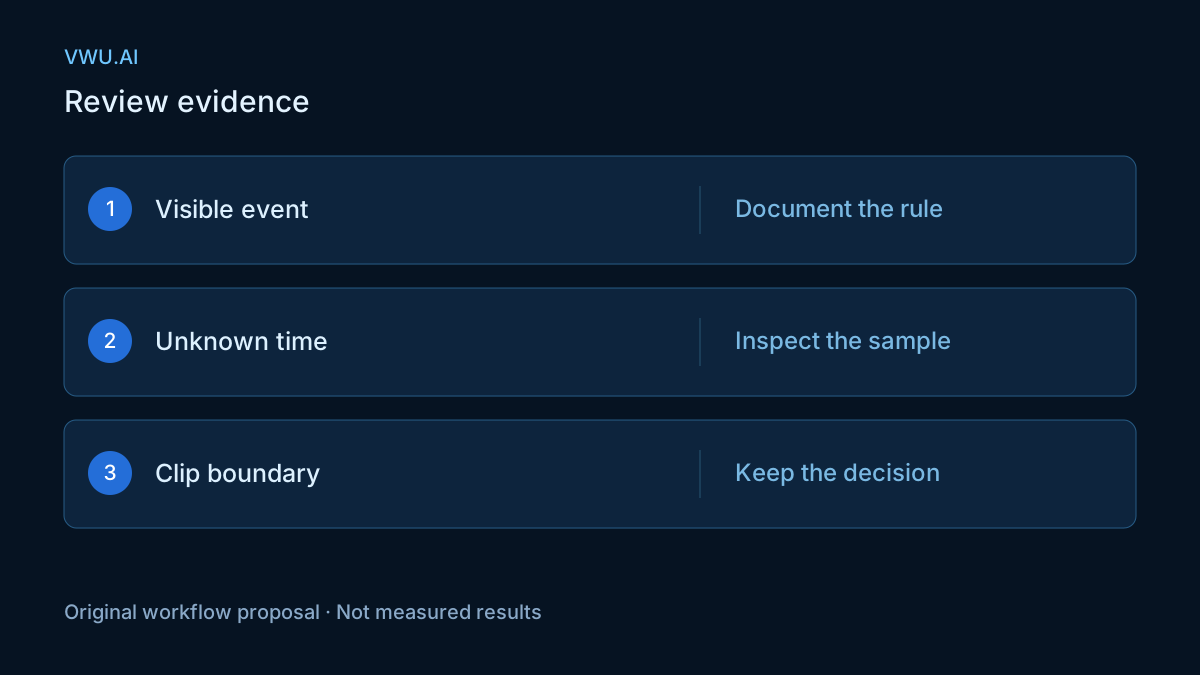
Before expanding the order, run a representative pilot through the actual reader and review interface. Check that an annotation at a stated timestamp lands on the intended frame. Have reviewers label a shared subset independently, discuss disagreements, and update the rule version before applying it to a larger batch.
The pilot acceptance record should include:
- The prediction target and reference-label method, with limitations.
- Definitions for each positive event, competing interpretation and unknown state.
- Time units, interval convention, clip-edge treatment and synchronization checks.
- Counts by relevant condition, including uncertain and rejected samples.
- Subject and source-group identifiers, split checks and duplicate handling.
- Agreed defect categories, rework procedure and reinspection responsibilities.
Do not accept or reject a dataset solely because a demonstration model reaches a reported score. Data conformance and model performance are separate decisions. A model evaluation also needs relevant held-out data, chosen metrics and a documented alert policy.
Use the VWU.AI data-requirements form to describe the missing behaviors, camera conditions and proposed acceptance tests. Confirm sample feasibility and the available label evidence before agreeing production scope.
Editorial note
Published by VWU.AI on October 29, 2026. This guide synthesizes public research and provides specification recommendations. It reports no original experiment, customer outcome or certification result. Public sources were checked on the review date; corrections can be sent to chan@vwu.ai.