
Published 2026-11-09 · VWU.AI
Multimodal Video Dataset Delivery: Manifests, Checksums and Provenance
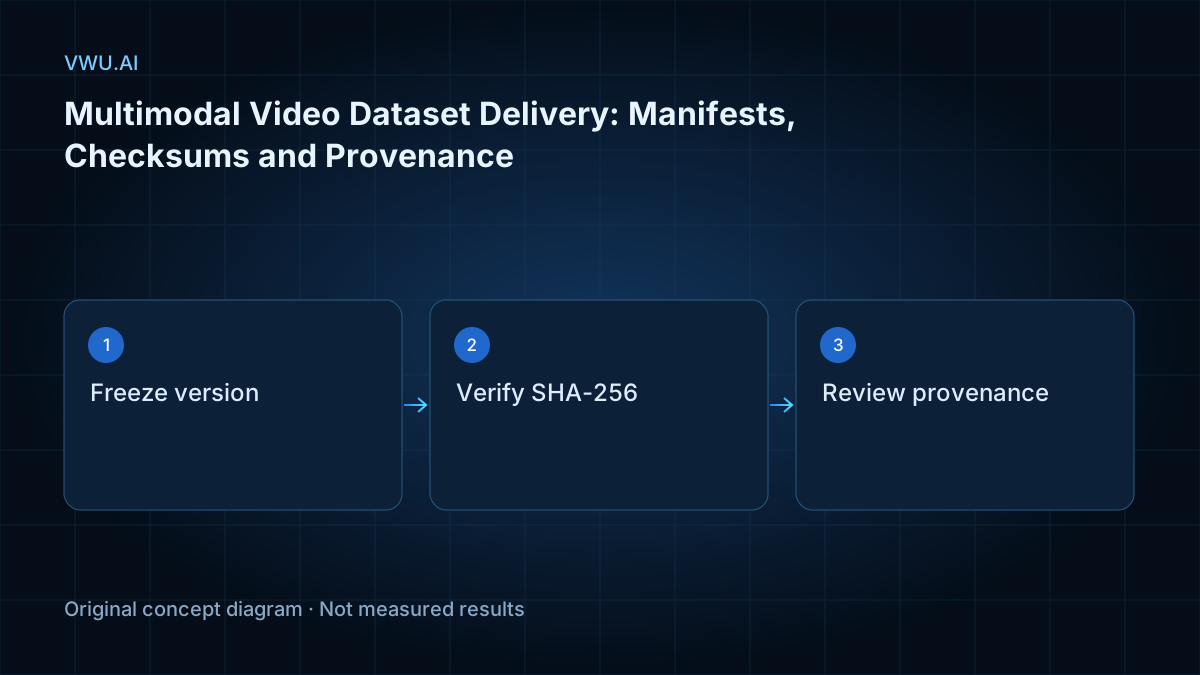
Validate video training-data deliveries with file manifests, explicit SHA-256 checks and versioned provenance while separating integrity, content quality and rights.
A downloadable archive is not enough evidence for accepting a multimodal video dataset. The receiving team needs to know which files belong to the delivery, whether their bytes match the agreed version, how media and annotations relate, and where source and usage restrictions are documented. Manifests and checksums make that handover inspectable. They do not prove annotation accuracy or permission to use the material.
Separate integrity, consistency and provenance
Byte integrity asks whether a received file matches its expected content. Semantic consistency asks whether media, labels and descriptions refer to the correct sample. Provenance describes how material was obtained or generated, processed and restricted. A file can pass its checksum while carrying incorrect labels or incomplete rights documentation.
Key takeaways:
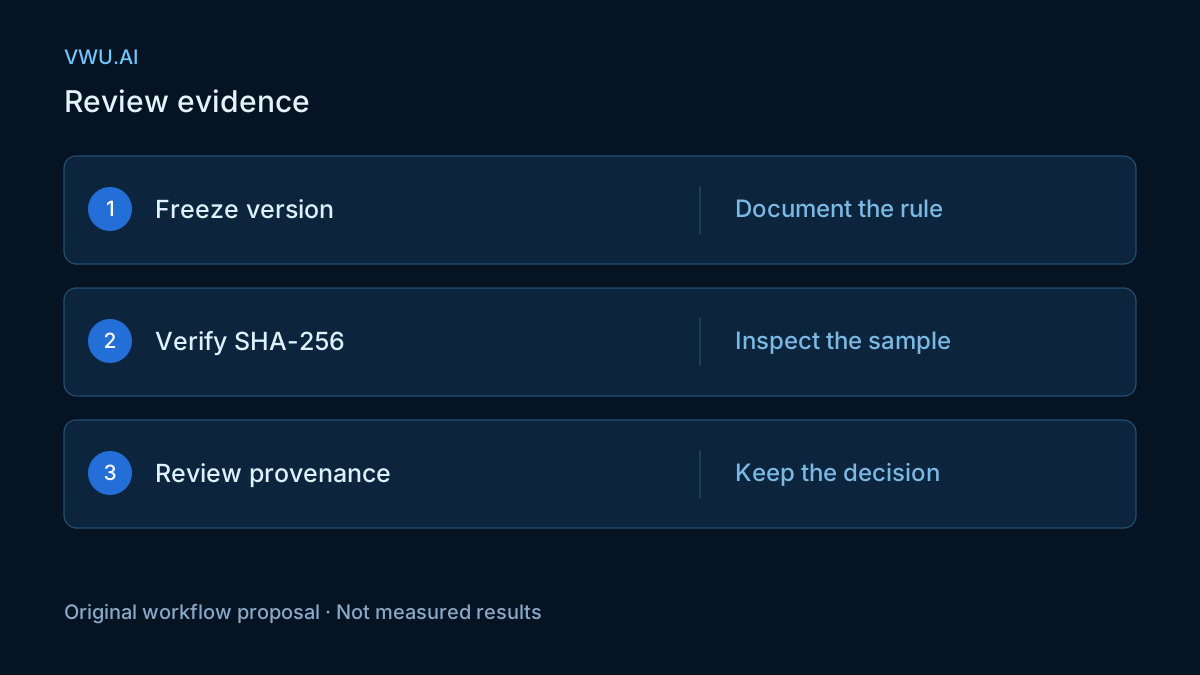
- Freeze a delivery version before generating manifests for media and annotations.
- Recompute checksums at the receiving side rather than relying on a sender's success screenshot.
- Accept file integrity, content quality and usage rights through separate checks.
Build a manifest that can be checked automatically
Useful fields include a relative path, byte size, explicitly named checksum algorithm and value, file type, sample identifier, related-file identifiers and dataset version. Paths should resolve from the delivery root, without depending on a sender's local machine.
Video, audio, subtitles, descriptions and annotations may have one-to-many relationships. Matching filenames are not sufficient proof of correct pairing. Record the relationship explicitly. If audio is outside the task, mark it as not applicable rather than creating an empty entry that suggests a missing asset is present.
RFC 8493 defines BagIt packaging with payload manifests that associate paths with checksums, distinguishing payload files from package metadata. A team can use compatible tooling or borrow the manifest concept. A custom format should not claim BagIt conformance without being validated against that specification.
RFC 8493: The BagIt File Packaging Format
Calculate checksums after freezing the files
Finish transcoding, renaming, redaction and annotation export before producing the delivery manifest. Any later byte change requires updated integrity evidence. Adding a watermark after hashing a video and retaining the old manifest creates an avoidable mismatch.
SHA-256 can be an agreed algorithm, with its encoding and calculation scope documented. An archive-level checksum checks the archive as one object. Per-file checksums after extraction help locate specific missing or changed assets. The two serve different purposes; a single package value is less useful when a receiver needs to identify which file failed.
Recompute and preserve the receiving report
After download, compare the expected inventory with actual files, including unexpected additions. Recalculate file checksums and distinguish missing files, byte-size differences and checksum mismatches. Save initial exceptions and the result after repair instead of allowing automatic retries to erase the evidence of a faulty handover.
Amazon S3 documents mechanisms for checking object integrity during transfer and storage. The applicable algorithm and full-object or multipart behavior depend on the actual upload and client configuration. Do not interpret an arbitrary ETag as a full-file SHA-256, or assume that a cloud-side success confirms the entire extracted dataset at the receiver.
Amazon S3 object-integrity documentation
Version provenance separately
Provide a source record describing collection or generation, processing steps, annotation-specification version and the location of permitted-use documentation. Clearly identify synthetic footage so a receiver does not mistake generated behavior for recorded evidence. Rights for people, voices and third-party assets need their own supporting records.
A checksum can help identify the exact source record delivered. It cannot establish that the record is truthful or that every proposed use is authorized. Likewise, a processing history should distinguish planned transformations from transformations confirmed to have been applied.
Use controlled identifiers where personal or restricted information is involved. Avoid exposing names or email addresses through publicly accessible filenames. Project owners should confirm the applicable requirements for their jurisdiction and intended use rather than treating a manifest as legal clearance.
Continue checking after hashes pass
Sample playback can reveal obvious faults but does not establish that every video decodes. If full decoding is required, agree on the tooling, scope and exception handling. Check whether annotations load and reference the correct media and version. Keep these findings separate from the integrity report.
Practical acceptance states include awaiting receipt, integrity passed, content review passed and unresolved issue. For a repair package, list added, replaced and removed files and issue a new manifest version. Receivers should not have to infer which files to overwrite.
Specify evidence before procurement
Agree on directory structure, media and annotation formats, checksum rules, manifest fields, source records and remediation steps at the start. Dataset volume is only part of the handover. Traceable file relationships and version evidence help prevent training teams from silently using mismatched material.
Review video-annotation acceptance checks
Discuss custom dataset delivery
Editorial note and further reading
Prepared by the VWU.AI editorial team from public research and official documentation for training-data planning and procurement. The workflow is a recommendation, not a report of completed model tests or customer projects.