
Video Annotation Quality: A Practical Acceptance Checklist
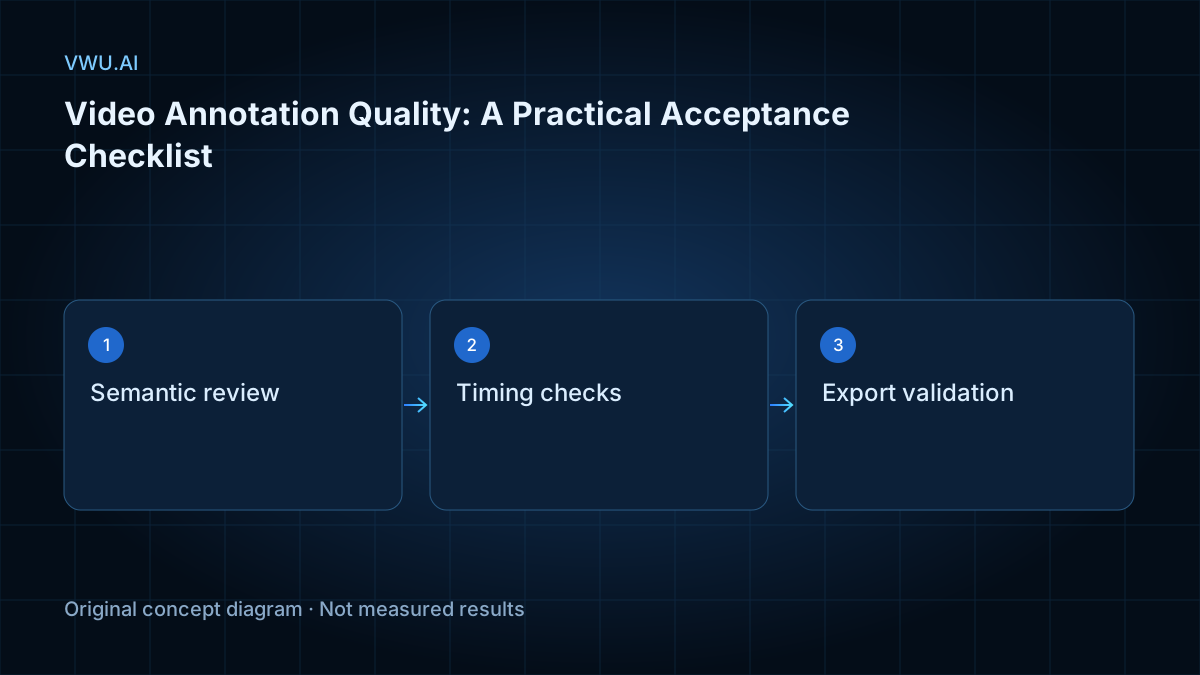
Video annotation quality should be accepted against a versioned task specification, a reproducible review sample and the actual exported files. One overall “accuracy” number is not enough to explain whether events were missed, actors were confused, boundaries drifted or labels were lost during export.
This guide helps data buyers turn quality expectations into inspectable acceptance checks. It covers behavior labels and temporal events, with notes for boxes and tracks where those are part of the agreed scope. For the wider ordering process, use the DMS and OMS procurement checklist. The examples are fictional and do not describe a customer project.
Key Takeaways
- Define annotation units, defect types and review rules before measuring quality.
- Check semantics, timing, identity and export integrity separately.
- Keep a representative audit sample and targeted difficult-case reviews distinct.
- Require evidence of corrections and reinspection, not only a final percentage.
Define what the annotation must represent
Start with the consuming model or analysis task. A whole-clip label, a temporal event, a per-frame object box and a continuous track are different deliverables. List the required fields and explain when each may be absent, unknown or not applicable.
For a temporal behavior label, define the actor, action, target where relevant, interval convention and visibility rule. For geometry, define the coordinate system, image dimensions and whether coordinates describe the delivered frame or a transformed view. For tracks, define identity continuity and how disappearance and re-entry are handled.
Use a versioned manual with examples and counterexamples. A field dictionary alone rarely resolves ambiguous boundaries. Ask the buyer's model owner and the annotation lead to approve the same examples, then preserve the decision and its rationale. This creates a reference for later disagreements rather than relying on memory.
Separate quality dimensions and defect severity
Measure the error that matters to the task. Correctly identifying a class does not imply that its time interval or actor is correct. Similarly, a valid JSON file may describe the wrong video.
| Dimension | Example defect | Evidence for acceptance |
|---|---|---|
| Semantic label | A passenger's action is assigned to the driver | Reviewed event and actor-role record |
| Completeness | A qualifying event is absent | Reference comparison and missing-event list |
| Timing | The start includes a long unrelated lead-in | Boundary review against the time base |
| Geometry or identity | A box uses the wrong frame size or a track switches people | Overlay inspection and continuity checks |
| Export integrity | Label IDs change meaning or timestamps exceed duration | Schema validation and reader round-trip |
| Provenance | Rule version or review status is missing | Manifest and change history |
Define severity using the intended use and agreed contract. An invalid time unit may invalidate a batch even when the visual annotations look reasonable. A spelling difference in an unused display label may have a different consequence. Do not impose an unvalidated universal defect threshold on every project.
Build a reference sample and an adjudication process
Choose a representative audit sample using a documented selection procedure. Preserve the sample IDs and selection seed where relevant. Make sure the sampling unit matches the claim: randomly selected adjacent frames should not be described as independent examples of all driving conditions.
Add a separate targeted review of rare events, occlusions, transitions and known confusing classes. This set helps find failure modes, but its deliberately difficult composition does not estimate the batch's average error rate without an appropriate sampling analysis. Report the two review sets separately.
CVAT's official automated quality-control documentation describes comparisons against a curated Ground Truth job. It also notes that its Honeypots mode requires unordered images and does not support video tracks. That distinction matters: a tool feature designed for shuffled images should not be assumed to validate continuous event timing. Check the deployed tool version, supported annotation type and product availability.
Have reviewers inspect reference examples independently before adjudication. The CVAT consensus documentation describes a workflow that compares replicated annotations. Agreement is useful evidence, but agreement alone does not establish correctness when reviewers share an unclear rule. Resolve the rule and update affected examples as well as the reference set.
Inspect time boundaries with a worked example
Suppose a fictional reference event occupies the interval from 2.0 to 4.0 seconds. A delivered annotation starts at 1.8 and ends at 4.4 seconds. The start is 0.2 seconds early and the end is 0.4 seconds late. Whether that is acceptable depends on a boundary rule agreed before review.
Temporal intersection-over-union compares the duration shared by two intervals with the duration covered by either interval. In this example, the intersection is 2.0 seconds and the union is 2.6 seconds, giving approximately 0.769. This is an arithmetic illustration, not a measured dataset result or a recommended passing threshold.
Retain boundary errors alongside overlap measures. A long event can have substantial absolute boundary error while retaining high overlap. Short events can be sensitive to small timing differences. Match events using an explicit one-to-one policy so duplicate predictions or annotations do not receive repeated credit for the same reference event.
Also check intervals truncated by clip edges, uncertain periods and simultaneous actions. A missing end observation is different from observing that an action ended. The in-cabin service examples can help teams discuss visible actions, but acceptance still needs a task-specific temporal reference.
Test the delivered export, not only the annotation interface
Load a pilot export with the actual downstream reader. Render labels back onto the delivered video and compare the result with the annotation interface. This can reveal frame offsets, changed class IDs, lost attributes and coordinate conversion errors.
Apply automatic structural checks before manual sampling:
- Every referenced clip exists and has a unique identifier.
- Timestamps use the declared unit and remain within the delivered duration.
- Event starts precede event ends under the agreed interval convention.
- Classes and attributes belong to the declared schema version.
- Required actor or track IDs refer to valid entities.
- Coordinate values match the stated frame geometry and transform policy.
- The manifest, annotation files and dataset version agree.
An intentionally empty annotation needs an explicit interpretation. It may mean “reviewed and no target event,” “not yet annotated” or “not evaluable.” Keep these states separate so a loader does not silently convert missing work into negative training data.
Close defects with traceable reinspection
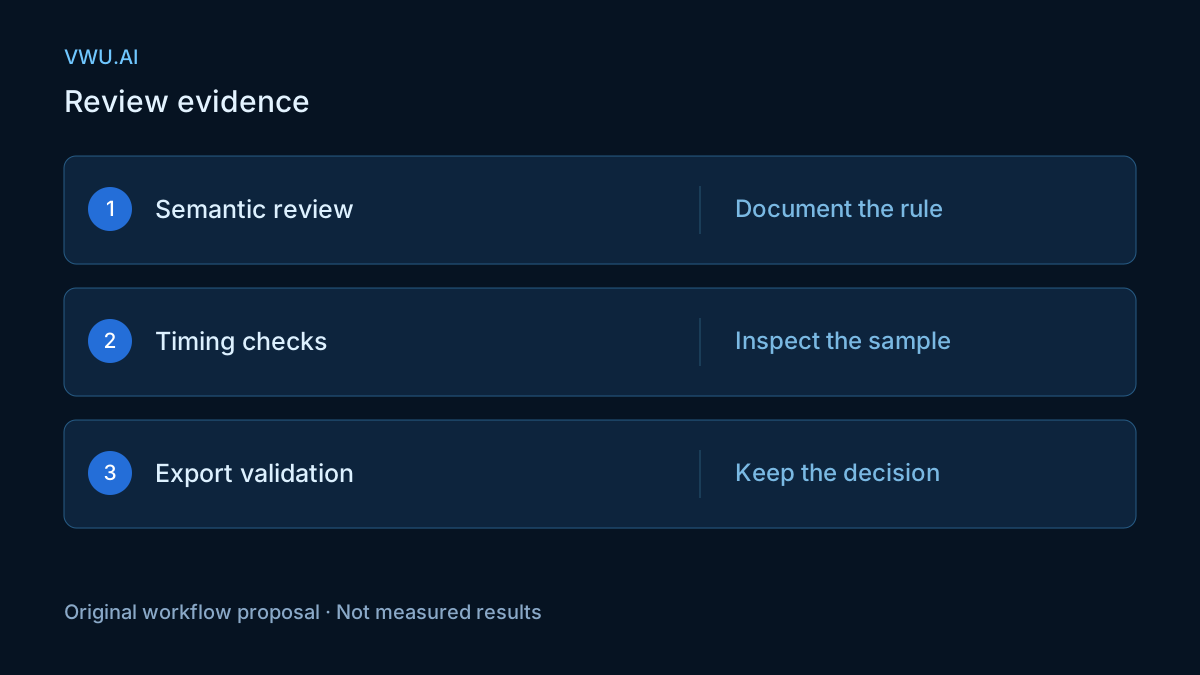
For each failure, retain the sample ID, defect category, reference evidence, responsible reviewer and disposition. Distinguish a single-item correction from a systematic rule or export problem. If a unit mismatch affects a batch, fixing the examples found by sampling does not resolve the rest of the batch.
Re-run affected structural checks after corrections and review a documented reinspection sample. Preserve the original finding and the corrected version. When the annotation manual changes, record which earlier labels need revisiting rather than mixing rule versions without notice.
The original Datasheets for Datasets paper, revised in 2021, proposes documenting dataset motivation, composition, collection and recommended uses. A delivery-specific quality record complements that broader documentation by making the acceptance decision reproducible.
The acceptance packet should identify the batch and rule versions, audit selection method, reference-set ownership, evaluable sample counts, defects by type, correction history and unresolved limitations. Keep model performance evaluation separate: an annotation batch can meet its specification without establishing deployment readiness.
Send the desired labels, export format and acceptance procedure through the dataset requirements form. Confirm the available annotation scope with representative samples before defining a larger delivery.
Editorial note
Published by VWU.AI on October 29, 2026. This guide presents quality-planning recommendations and a fictional timing calculation. It reports no customer acceptance rate or model result. Tool documentation and primary research were checked on the review date; corrections can be sent to chan@vwu.ai.