
Published 2026-11-05 · VWU.AI
Night and Infrared Cabin Data for Multimodal VLM Evaluation
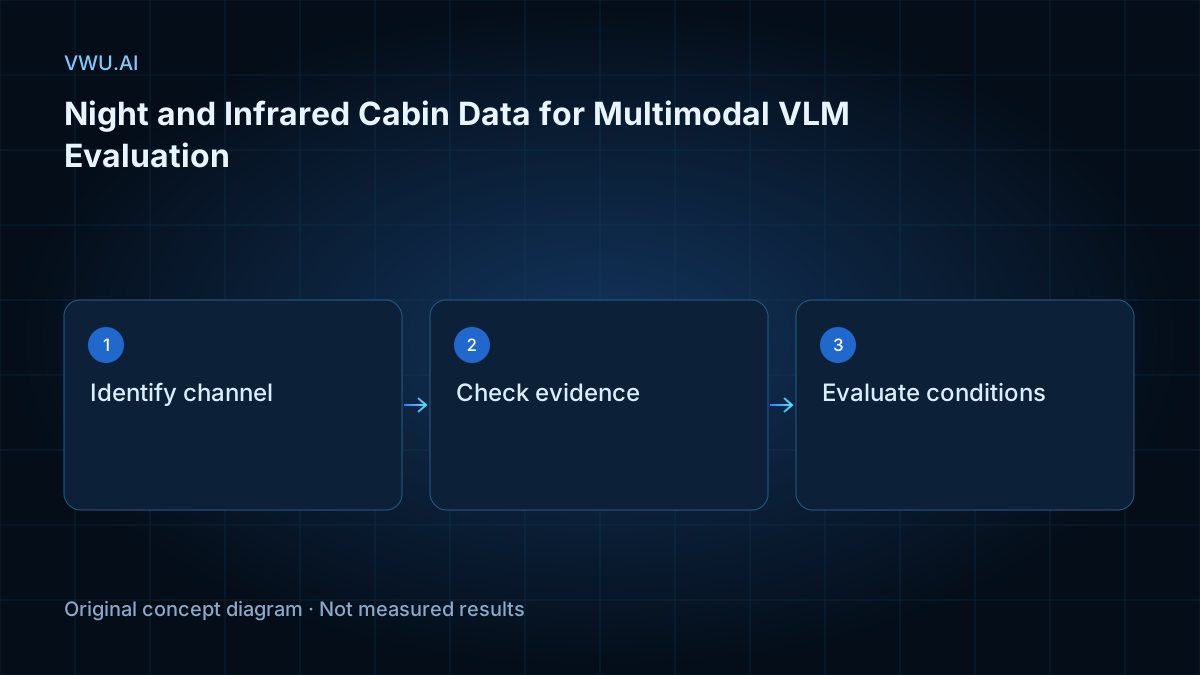
A practical acceptance workflow for night and infrared cabin data: distinguish sensor channels, preserve observable evidence, and evaluate multimodal models by imaging condition.
Accepting nighttime cabin video requires more than deciding whether a person looks clear. Buyers need to establish which channel the model receives, whether the evidence required by the question survives preprocessing, and what the model should say when that evidence is absent. A readable infrared image does not establish that a general vision-language model understands that sensor domain. The workflow below is a procurement and evaluation recommendation, not a report of measured performance or certification.
Separate nighttime conditions from infrared channels
Nighttime describes the environment; infrared describes imaging information. Record illumination, delivered image channel, camera position, exposure configuration and available illuminator information as separate fields. Mark unavailable device details as unknown. A monochrome appearance alone does not identify the wavelength or capture setup.
The original DMD work described multiple visual modalities. The current official repository states that simulator recordings, infrared streams and depth streams have been removed from its public release. A paper's original capture scope is therefore not a substitute for inspecting the package actually delivered. Record the release version and check its inventory before designing a test that depends on a particular modality.
DMD official release information
Define the evidence each task requires
Write an evidence requirement for every requested answer. Describing an object interaction needs visible hand-object context. Describing eye direction needs usable eye information. Head orientation can remain observable even when eye direction is not. A forward-facing head should not automatically become a forward-gaze label.
Ask the model to distinguish observations from uncertainty and to identify the relevant portion of the clip. Apply the same distinction to reference annotations. If reflections hide the eyes, an unobservable label is more defensible than forcing the frame into a normal-behavior class. A richer natural-language description must not invent evidence that the camera did not capture.
Build condition-specific acceptance slices
Inspect difficult conditions deliberately rather than sampling only attractive footage. Recommended slices include stable illumination, strong light entering through windows, illumination transitions, reflections on glasses, head turns and small objects near the face. Keep the observable and unobservable cases distinct within those conditions.
These are suggested inspection categories, not a universal distribution or a prescribed purchase ratio. Record actual delivered counts and identify gaps. For each slice, distinguish correct answers, incorrect answers and explicit abstentions. The same question may become unanswerable when the sensor channel changes, so verify that its reference answer remains supported.
Preserve preprocessing provenance
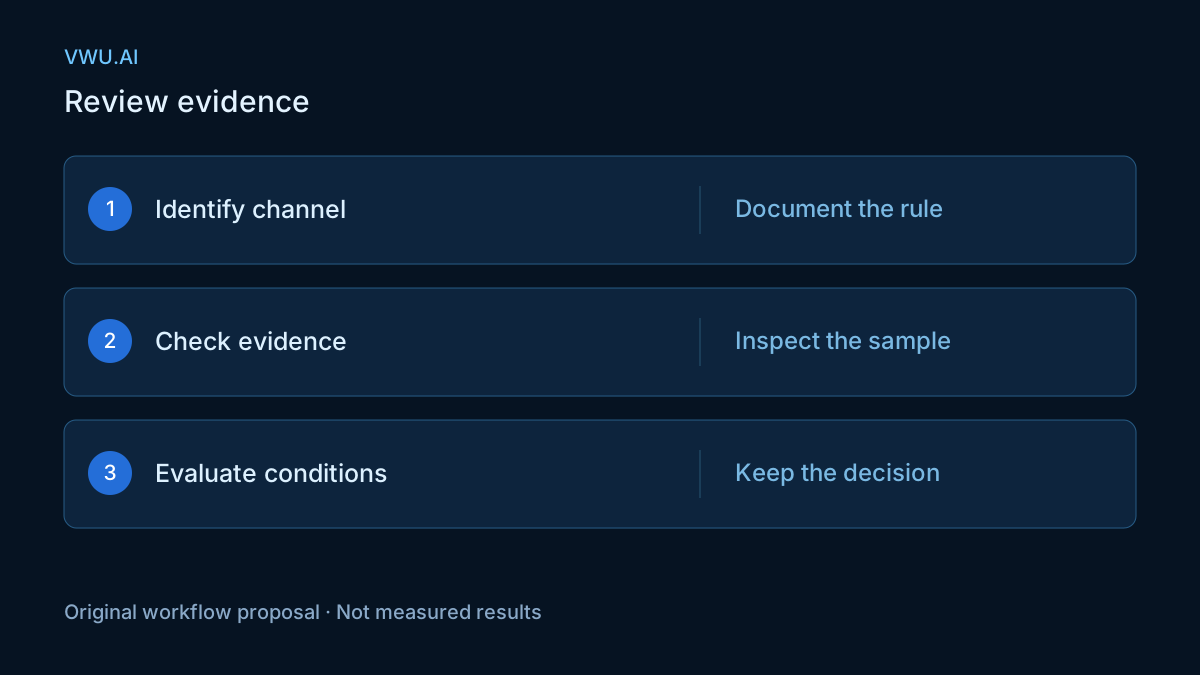
A model may accept a three-channel image even when an infrared source uses a different representation. Preserve the original file, decoder, intensity mapping, resize parameters and cropping configuration. Replicating a grayscale channel three times is an input conversion; it is not evidence of infrared training.
Review representative clips at source resolution and at the exact size supplied to the model. Repeat the check after temporal sampling. If a phone or an eye detail disappears during resizing, document that information loss before attributing the error to reasoning. The evaluation record should identify the actual frames that reached the model rather than only the original video filename.
Use research without transferring its claims
A 2025 DMD-based occlusion-aware monitoring study handles RGB and infrared models separately and discusses challenging illumination and occlusions. This is a useful reason to inspect channel-specific observability. Its findings do not establish the performance of another multimodal model, a different camera, or a VWU.AI deployment.
Occlusion-aware driver monitoring research
A 2026 driver activity description study evaluates fine-grained descriptions as a dedicated VLM task. That task-specific work should not be read as proof that any general model can accept infrared cabin frames without additional validation. Keep the exact model version, prompt and sensor configuration in the experiment record.
Driver activity description research
Make the acceptance package reproducible
Request a file manifest, modality description, condition inventory, observability rules, preprocessing configuration and reviewed example decisions. Run a small reviewed package through the entire workflow before expanding the order. Agree acceptance criteria before scoring the final delivery; do not borrow a numerical threshold from an unrelated publication.
Explore driver monitoring training data
Editorial note and further reading
Prepared by the VWU.AI editorial team from public research and official documentation for training-data planning and procurement. The workflow is a recommendation, not a report of completed model tests or customer projects.