Published 2026-11-17 · VWU.AI
Public or Custom DMS Data? A Procurement Decision Guide
Compare public driver-monitoring datasets with custom data by permitted use, camera fit, labels, coverage and acceptance evidence before commissioning a new collection.
Start with public data when its permitted use, camera view and labels fit your experiment. Commission custom data when a documented requirement remains uncovered. A dataset being downloadable does not establish that its footage may be used commercially, redistributed or incorporated into a customer deliverable.
The useful decision is not “free versus paid.” It is whether the available data answers your model question under an acceptable usage agreement. Custom production can address a missing requirement, but it still needs sample validation; paying for data does not prove fitness for deployment.
Define the job before comparing sources
Write one sentence describing the intended prediction: for example, visible phone-to-ear interaction from a fixed cabin camera. Then record the intended users, deployment camera, output labels and evaluation conditions. Keep this separate from inferred intent or medical state. A visible yawn label is not automatically a diagnosis of fatigue.
List the requirements that would make a source unusable, such as an incompatible licence, a missing view or no reference labels for the target action. Other differences may be manageable. A different annotation format can sometimes be converted; an unobserved body region cannot be recovered by changing the file extension.
Apply a decision table to the actual files
| Question | Public data may be sufficient when… | Consider custom data when… |
|---|---|---|
| Permitted use | The current terms cover the intended experiment and distribution | Required rights are unavailable or unclear and must be negotiated |
| Camera fit | Target body regions are observable under relevant views | Your mounting position or occlusions create a documented gap |
| Labels | Definitions and reference evidence match your task | Required actions, temporal boundaries or unknown states are absent |
| Coverage | Relevant conditions and normal counterexamples are represented | Important combinations remain missing after inspection |
| Acceptance | Files, labels and partitions can be checked reproducibly | You need an agreed pilot, correction process and delivery specification |
This table is a procurement recommendation, not a ranking of vendors. A project may combine sources rather than choose a single winner.
Inspect the current release, not an old dataset summary
The official DMD repository currently describes a revised release with reduced available material. Record the release you inspected and read its current access and use terms. Do not assume a paper’s original modality list describes today’s download.
For each candidate, retain its source URL, revision or retrieval date, access conditions, licence text and a small verified inventory. Check actual files for frame rate, duration, available views and annotation fields. Record missing items explicitly. Keep rights questions with the project owner or a qualified adviser; a repository’s software licence must not be assumed to settle every right in the underlying footage.
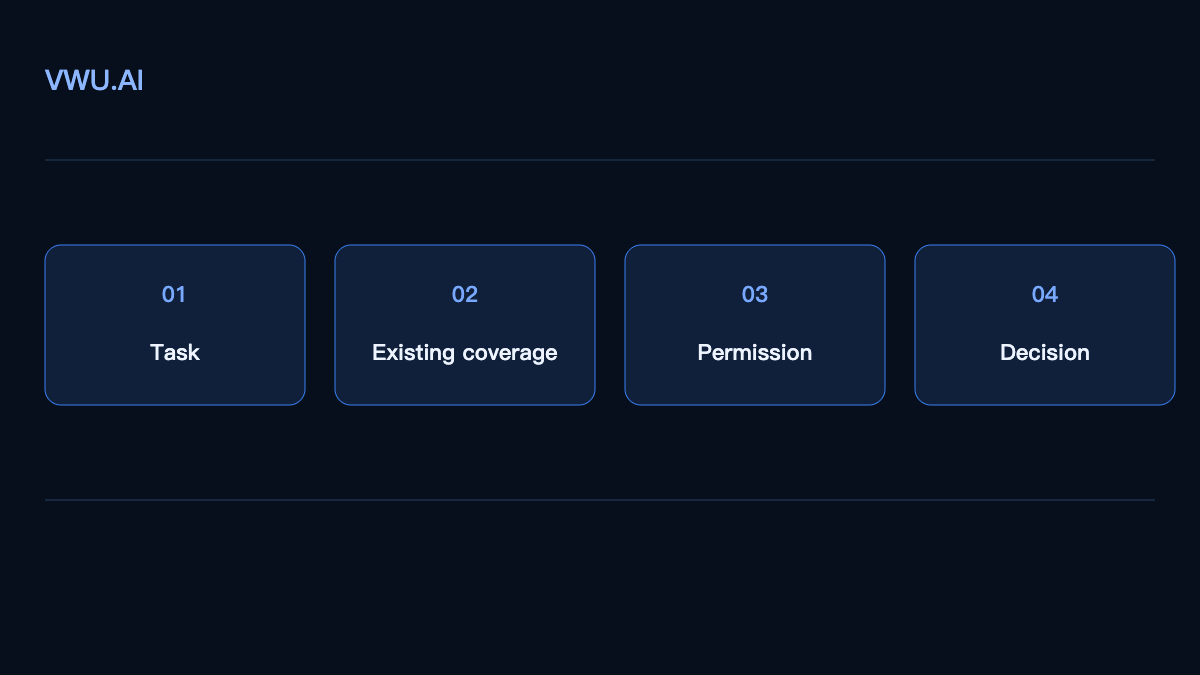
Original editorial workflow diagram; not measured results.
Run a small integration check before buying more
Load a representative subset into the pipeline you intend to use. Confirm that label names survive conversion, timestamps reach the expected frames and missing observations are distinguishable from negatives. Review normal driving alongside the target behavior. This check should produce a list of concrete mismatches, not only an overall impression of visual quality.
Protect the evaluation boundary. The grouped cross-validation documentation discusses dependent samples. For a procurement project, document which people, source recordings and generated variants must stay together before assessing new data. See the DMS split guide for the detailed overlap checks.
Turn each remaining gap into a custom brief
A useful brief names the missing condition, why the current data cannot answer it, the output required and how a pilot will be checked. Replace “more diverse video” with a reviewable request, such as a specified mounting view with glasses-related occlusion and agreed visible-state labels. This is a scope example, not a promise that a particular supplier can deliver it.
Ask the supplier to confirm feasibility, rights, accepted quantity, rejected-output handling and included corrections in writing. Use the DMS cost guide to compare billing units. Do not commit the full batch until the pilot files and labels can be read and reviewed by your team.
Keep a decision record
Retain four outcomes: suitable as supplied, suitable after documented conversion, suitable only for a limited experiment, or unsuitable. State what evidence supports the outcome and what remains unknown. Revisit the record when a source licence, release, target camera or model task changes.
Discuss a missing cabin-data requirement with VWU.AI. Share the task, source constraints and proposed acceptance checks; confirm availability before ordering.
Sources and scope
Primary sources were checked on November 10, 2026. The comparison, worksheet and procurement steps are editorial recommendations. This guide reports no customer result, original experiment, guaranteed performance or legal determination. Contact chan@vwu.ai for corrections.
Image credit
Car dashboard (22954713844) — freestocks.org from Olsztyn, Poland. CC0 1.0.
Original image and attribution
Reference photo for context. Resized and cropped for display; no endorsement is implied.