
Published November 10, 2026 · VWU.AI
Driver Monitoring Dataset Cost: 8 Specifications to Define Before a Quote
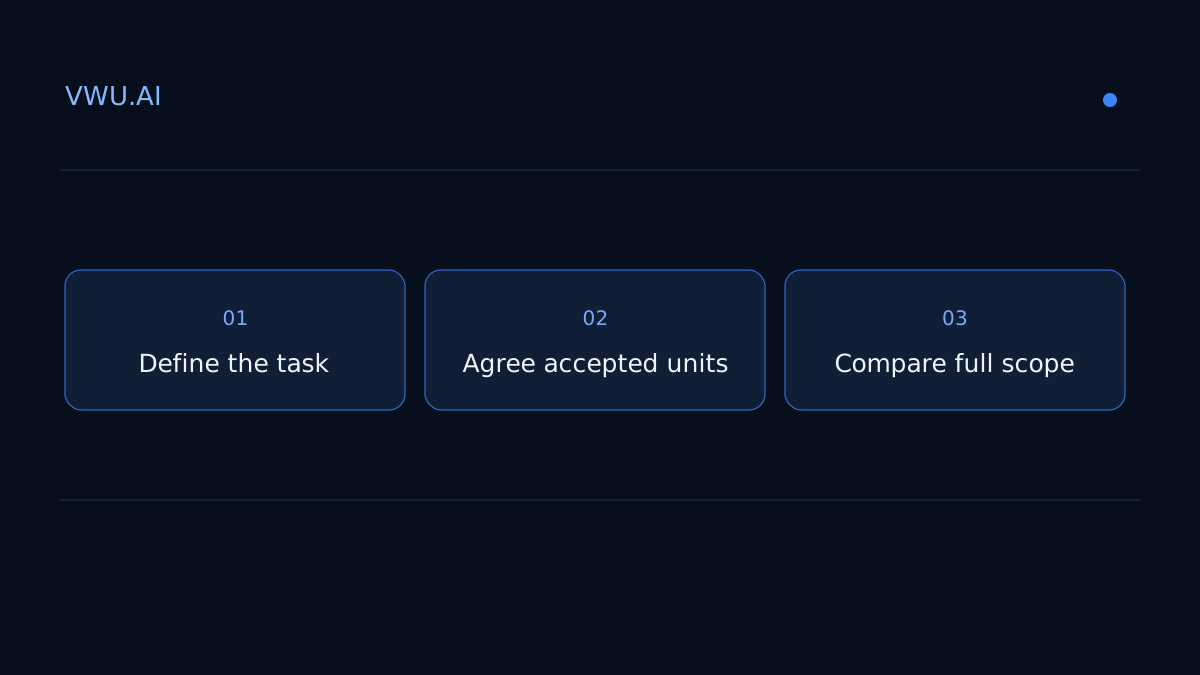
There is no useful universal price per DMS video. First define what counts as an accepted unit, the camera conditions, labels, review process and permitted use. Compare written scopes before comparing totals. This guide is a procurement method, not a VWU.AI price list or market-rate survey.
What are you actually buying?
A video file, an accepted behavior clip and an annotated frame are different billing units. A quote for generation may exclude rejected outputs, annotation, rights review, secure transfer or rework. Ask whether you pay for attempts or for accepted deliverables, and whether a multi-camera event counts as one unit or several.
Eight specifications that change the scope
| Specification | Define in the request | Why it affects the quote |
|---|---|---|
| Task and behavior | Observable actions, event boundaries, unknown states and normal counterexamples | A visible action is different from a clinical or inferred state. Ambiguous labels need additional review. |
| Accepted quantity | Accepted clips, duration range, usable minutes and camera views per event | File count alone cannot reveal duplicates, rejected clips or effective coverage. |
| People and coverage | Required variations in appearance, accessories, clothing, behavior and cabin | Coverage requirements and difficult combinations affect setup and review effort. |
| Camera and modality | Mount position, field of view, resolution, frame rate; RGB or a specified sensor modality | A grayscale image is not evidence of infrared sensor equivalence. Confirm each requested output. |
| Source and production | Real capture, synthetic generation or a documented combination | Recruitment, permissions, scene setup and generation review are different cost items. |
| Annotations | Clip labels, temporal events, boxes, keypoints or masks; frequency and export format | Per-clip, per-frame and per-object prices cannot be compared without converting the unit. |
| Quality and rework | Defect rules, sampling method, reviewer responsibilities and included correction rounds | An undefined acceptance rule leaves the final accepted quantity uncertain. |
| Rights and delivery | Permitted training/evaluation uses, redistribution, retention, packaging and milestones | Licensing scope, delivery responsibilities and changes must be explicit. |
Use an equation, not an invented market price
For planning, separate setup + production or capture + annotation + agreed quality review + rights and delivery + approved changes. Identify which items are included in each quote so they are not counted twice. Effective cost per accepted clip is the agreed total divided by clips that pass the agreed acceptance rules. For usable-minute comparisons, also report accepted duration. This is a comparison method; it does not predict your project price.
A worked example without fictional rates
Suppose a hypothetical request requires 120 accepted clips of 6 seconds each, with one camera view. That is 720 seconds, or 12 accepted minutes. At a constant 30 frames per second, labeling every frame gives 21,600 frame positions. Labeling every fifth frame gives 4,320 positions; that does not mean the same amount of information is preserved. If two people require separate tracks, the annotation unit must also state how people are counted. These are arithmetic examples, not recommended volumes, prices or a claim of available inventory.
Compare suppliers on the same acceptance basis
- Does the price include accepted outputs or every attempted output?
- Are duration, camera views, label frequency and export format identical?
- Are duplicate checks, uncertain labels and rejected samples reported?
- What corrections are included, who reviews them and how are scope changes approved?
- Are licensing, tax, currency, transfer charges and quote validity stated separately?
Copy this request for a scoped quote
Task / behavior:
Intended model use:
Accepted clips and duration range:
Camera setup / modality / frame rate:
Required variations and counterexamples:
Real or synthetic source requirements:
Label definitions / annotation frequency / format:
Pilot acceptance and rework rules:
Permitted use / retention / delivery date:
Budget range, if available: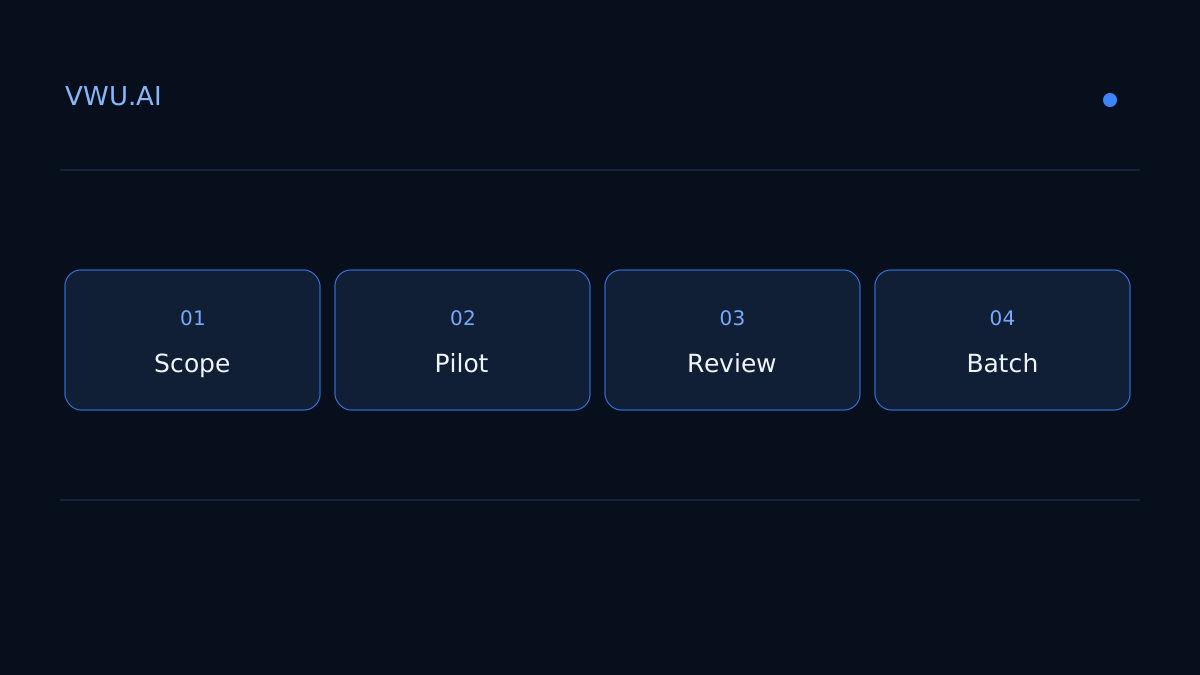
Start with a representative pilot
Agree the pilot scope and its price before work starts; do not assume samples are free. Include normal examples and difficult conditions from the planned batch. Read the files in your own pipeline, inspect labels against the video, document defects and freeze the approved rule version. Then confirm the batch scope, acceptance responsibilities and treatment of rejected outputs. Dataset conformance and downstream model performance require separate checks.
Sources and scope
Public vendor pages show that collection scope and annotation billing units vary. They are vendor-specific offers, not a market benchmark or VWU.AI pricing. Checked on November 10, 2026. All checklists and examples above are editorial procurement recommendations; no original experiment or customer result is claimed.
- DMS camera and behavior scope: LXT
- Annotation billing units: InitLabel
- DMS labels and camera metadata: original research