
Synthetic vs Real In-Cabin Data: Design a Useful Evaluation
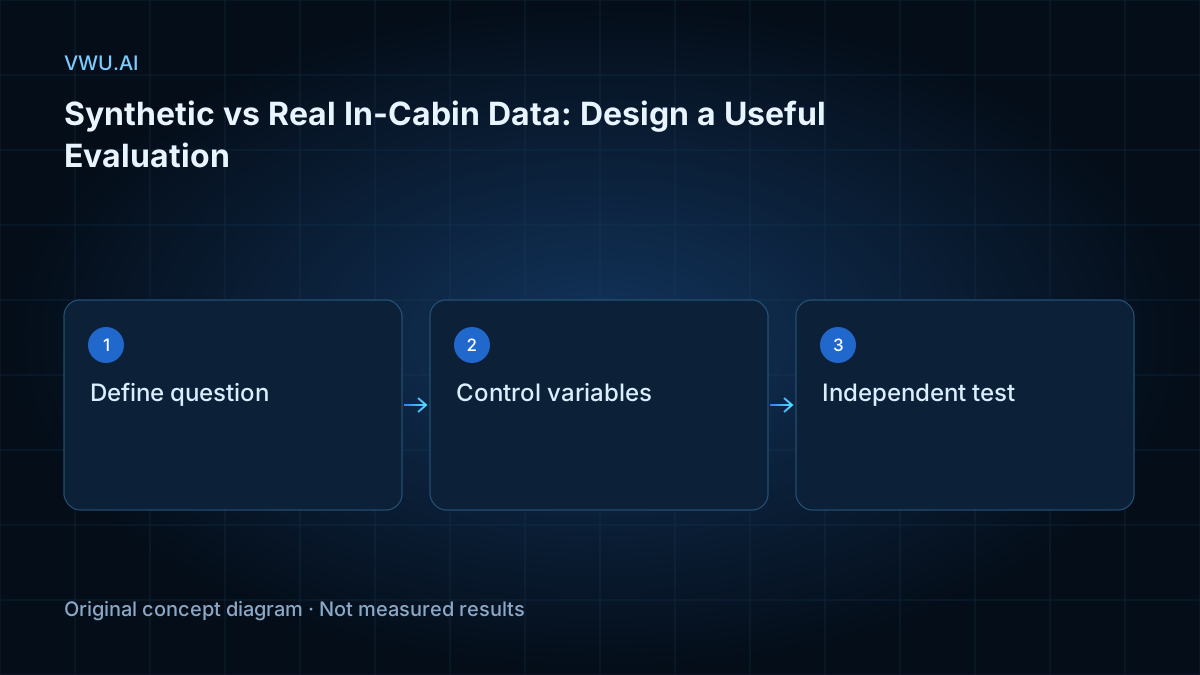
Choose between synthetic and captured in-cabin training data by testing the contribution to a defined task on independent, relevant evaluation data. Image realism alone does not establish model benefit. A useful comparison separates the question being asked, the training budget and the evidence used for the final decision.
This guide proposes an evaluation plan for driver and occupant monitoring projects. It is a research-based planning framework, not a report that one data source performs better. For requirements, provenance and delivery checks, start with the DMS and OMS dataset procurement guide.
Key Takeaways
- Define whether the experiment tests supplementation, replacement or a particular coverage gap.
- Keep relevant captured evaluation data independent of training and selection decisions.
- Compare labels, sensors, conditions and compute budgets, not just clip counts.
- Report condition-level failures and uncertainty alongside any overall result.
Compare origins without assuming either is complete
Captured data records people and a physical imaging system. Its usefulness still depends on collection conditions, permissions, labels and how closely the sample represents deployment. A captured staged action is not automatically naturalistic behavior. Synthetic data is generated; its usefulness depends on the represented conditions, output fidelity, label validity and evaluation results.
Neither origin resolves every data problem. Generated events can be visually plausible while containing incorrect interactions or inconsistent labels. Captured events can have occlusion, weak reference labels or poor coverage of rare conditions. Record these limitations explicitly instead of attaching a blanket quality claim to the origin.
| Decision dimension | Questions for captured data | Questions for synthetic data |
|---|---|---|
| Scenario evidence | Was the behavior naturalistic or performed? | Does the output visibly match the intended scenario? |
| Imaging | Which actual sensor and processing pipeline produced it? | Which sensor characteristics are represented and validated? |
| Labels | How were events observed and adjudicated? | Are labels derived from generation intent, output review or both? |
| Coverage | Which conditions are absent or scarce? | Which variations are controllable, and which remain unverified? |
| Rights and provenance | What collection and use records are available? | What source assets and generation-use restrictions apply? |
Use the table to identify missing evidence. It is not a price ranking or a promise that a vendor can supply either type of data. The VWU.AI in-cabin service overview provides a starting point for a project-specific scope discussion.
State one purchasing question for each experiment
Three questions lead to different experiments. A supplementation question asks whether adding synthetic examples helps a baseline. A replacement question asks whether synthetic examples can substitute for some captured training data under defined constraints. A coverage question asks whether a specific missing scenario is learned better without unacceptable changes elsewhere.
Write the primary question before selecting a training mixture. If a mixed-data run has more examples, more training steps and a new augmentation policy, an observed difference cannot be attributed cleanly to origin alone. That run may still answer a business question about the whole package, but report the package that changed.
The original domain-randomization paper by Tobin and colleagues, published in 2017, studied transfer from simulated images to real-world robotic object-localization and grasping tasks. It provides evidence for a method in that setting. It does not establish a DMS performance guarantee or prove that any generated video will transfer successfully.
For an in-cabin purchase, treat transfer as a hypothesis to test against the buyer's target task and data. Keep the distinction between a motivating research result and the evidence required for this procurement decision.
Freeze evaluation data before choosing the mixture
Define a held-out set that reflects the conditions for which the team intends to claim results. Include relevant actors, camera views, lighting and non-target behavior. If an important condition is absent, record the gap; do not silently extend conclusions to it.
Separate model development data from the final evaluation set. The scikit-learn cross-validation documentation explains that repeated selection using test results leaks information into model choices. Its grouped validation guidance also addresses repeated subject samples. Use those principles when assigning people, original recordings and related generated sources.
Do not use a held-out image as an input for generating training variants. Track source relationships and inspect duplicates before splitting. When source lineage is unavailable, document that limitation and narrow the independence claim. A dataset name alone does not prove that the training and test material are independent.
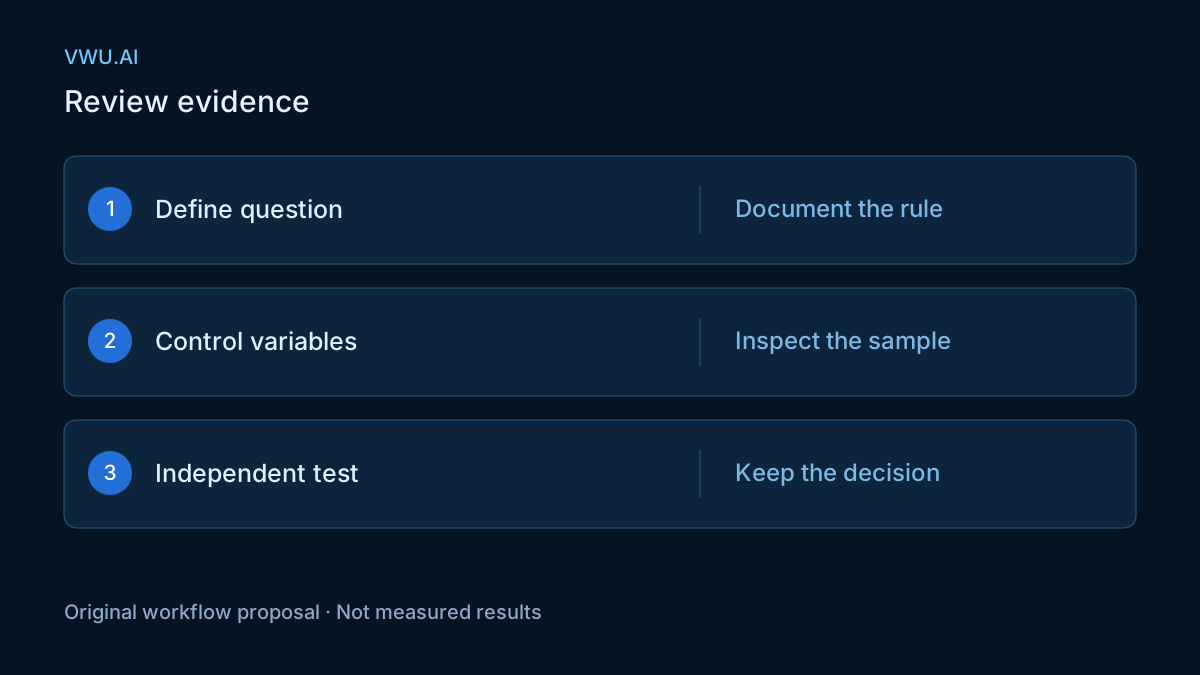
Run a small comparison with named controls
Consider a hypothetical project whose current training data misses a particular hand-object interaction. The following experiment arms are a planning example, with no invented results:
| Arm | Training input | Question it can help answer |
|---|---|---|
| A: baseline | Current eligible captured training set | What does the existing approach achieve? |
| B: added synthetic | A plus reviewed synthetic examples of the gap | Does this supplementation package help? |
| C: added captured | A plus additional eligible captured examples, if available | How does another way of filling the gap compare? |
| D: replacement | A specified portion of A replaced with synthetic examples | What changes under the chosen replacement budget? |
Define the number of eligible examples, sampling weights, model initialization, training steps, preprocessing and tuning procedure for each arm. Hold them constant when they are intended controls; document intentional differences. A fixed-example comparison and a fixed-compute comparison answer different questions and should not be presented as interchangeable.
Use the same evaluation protocol across arms. Where feasible, repeat runs with specified random seeds and report the variation. Do not select only the most favorable run. Keep a record of exclusions and failed runs so the decision can be reconstructed.
Examine labels, sensors and failures before averages
Review a sample of synthetic outputs against the annotation manual before training. A generation request that names “phone use” does not prove the final clip contains a correctly visible phone interaction. Check actors, objects, temporal continuity and the exported event boundaries.
Check the imaging assumptions separately. RGB, depth and near-infrared signals are different measurement types; a visual style change does not establish equivalence to a target sensor. If the model is expected to consume a particular modality, the evaluation needs suitable data from that modality and a defensible explanation of any conversion.
Predefine metrics at the task's prediction unit. Report relevant classes and conditions separately, including the gap the synthetic examples were designed to address. Also inspect conditions where performance worsens, false alerts on non-target behavior and examples that cannot be evaluated reliably. Missing or very small evaluation groups should remain visible as evidence gaps.
Make the acceptance decision narrower than the experiment
A dataset can meet its file, label and coverage specification without improving a chosen model. Conversely, a favorable model result does not excuse incorrect rights records, broken annotations or poor reproducibility. Keep procurement acceptance and model adoption as separate sign-offs.
The Model Cards for Model Reporting paper, revised in 2019, proposes reporting intended use, evaluation procedures, relevant conditions and limitations. Use that reporting principle to state exactly which data mixture and test conditions support a decision, without treating the framework as automotive certification.
Before expanding a purchase, record:
- The primary hypothesis and which variables changed across arms.
- Dataset versions, source groups, exclusions and duplicate checks.
- Reference-label methods and unresolved label or sensor limitations.
- Training settings, seeds, tuning access and evaluation ownership.
- Results by relevant condition, uncertainty and known failures.
- Separate decisions on data conformance and model suitability.
Bring the gap description and proposed controls to the data-requirements form. Confirm which samples and provenance records are available. Do not commit to a broad replacement claim when the evidence only supports a narrow supplementation use case.
Editorial note
Published by VWU.AI on October 29, 2026. This guide describes a proposed comparison design. No experiment was run for this article, and no performance, price, privacy or certification advantage is asserted. Public sources were checked on the review date; send corrections to chan@vwu.ai.