
Published 2026-11-08 · VWU.AI
Synthetic Data: Long-Tail Coverage for Embodied AI
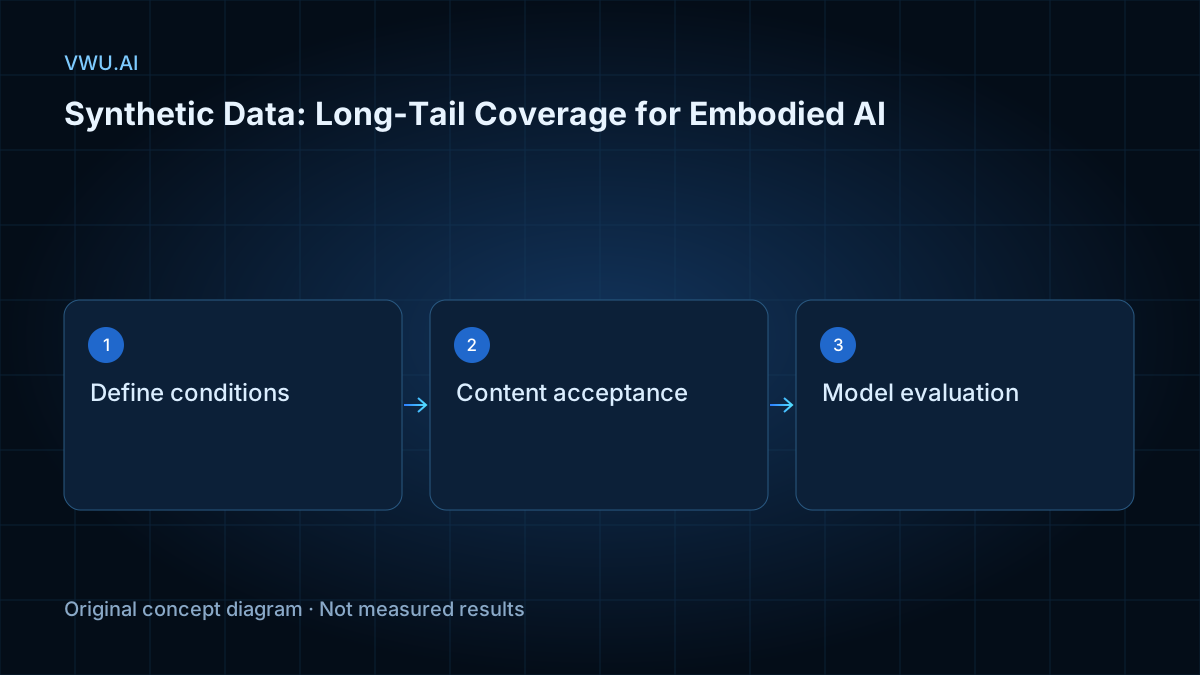
Plan synthetic video around task-relevant condition combinations, separate generated and validated coverage, and define evidence for long-tail dataset acceptance.
A useful synthetic-data coverage matrix identifies task-relevant combinations for which a model team lacks dependable evidence. It connects a scenario request to observable conditions, an acceptance decision and an evaluation plan. It should not turn the number of generated clips into a claim about model reliability. The workflow below is a proposed planning approach for embodied AI and in-cabin video, rather than a report of product test results.
Define the task before defining the long tail
A robot project may need to recognize a person handing over an object. A cabin-monitoring project may need to distinguish a passenger passing an object from a driver picking up a phone. Visually similar footage can support different decisions. Start with the model input, expected output, permitted uncertainty and deployment boundary.
Key takeaways:
- Define long-tail conditions through their effect on the task, rather than unusual appearance alone.
- Track generation, content acceptance and model evaluation as separate evidence states.
- A completed synthetic-data matrix describes designed inputs; it does not establish real-world performance.
Turn conditions into inspectable rows
Give each row a meaningful condition combination. Suggested fields include the target action, participant relationship, observation direction, visibility, environmental condition, source type and evidence location. Add an explanation of why the combination matters and a rule for deciding whether a clip belongs in it.
For an object-handover task, useful combinations might involve reach direction, object occlusion and whether the transfer completes. For a cabin task, they might involve passing direction, hand visibility, object type and driver participation. These are illustrative planning dimensions, not an exhaustive test suite or statements about event frequency.
Avoid expanding every possible combination mechanically. A factor that changes neither observability nor the decision may belong in metadata. A factor that creates label confusion deserves closer attention: picking up a phone and picking up a similarly sized wallet might need deliberately paired examples.
Separate three evidence states
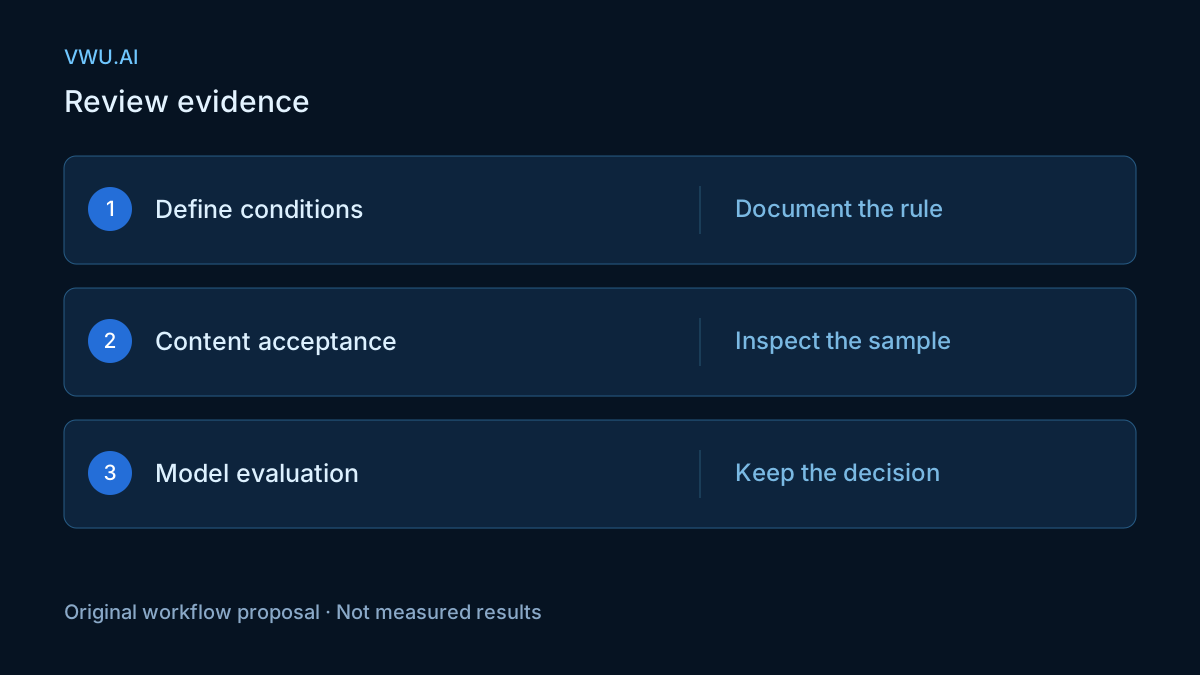
Generated means the file exists. Accepted means a reviewer confirmed that the clip meets the stated conditions and that the action, object relationships and visible evidence are coherent. Evaluated means a named model version has been assessed under a documented protocol. Use separate fields rather than one completed flag.
An ambiguous clip can be useful, but it should not count as a confidently labeled positive merely because the requested event was included in its generation brief. If a condition cannot yet be produced reliably, record the gap and the reason. Substituting a superficially similar clip hides the limitation from the receiving team.
Use domain randomization as a design reference
The 2017 domain-randomization paper by Tobin and colleagues examined changing rendered simulation conditions to transfer vision models to a real robotic task. It provides a research precedent for making variation explicit. Its experimental findings do not establish equivalent benefits for cabin video, human behavior or every embodied model.
Original domain-randomization paper
For delivery planning, distinguish parameters requested from a generator from conditions confirmed in the resulting footage. A low-light prompt is an instruction to a production process, not evidence that the output satisfies an agreed low-light criterion. Review actual frames and retain the acceptance reason.
Prioritize gaps with a small reviewed batch
Before scaling production, use a small batch to test whether the matrix supports consistent decisions. If reviewers cannot distinguish adjacent rows, refine the definitions. If a critical row contains only ambiguous footage, improve observability instead of multiplying the same uncertainty.
Prioritization can consider task impact, missing evidence and production feasibility. The ordering is a project decision. Do not present arbitrary weights as a universal standard. Preserve the reasons for revisions so the team can explain why a later batch emphasizes a different set of conditions.
Evaluate value separately from coverage
After adding training material, compare model versions under the same evaluation definitions. Report the relevant subsets and limitations rather than implying that a fuller matrix guarantees a better model. Without independent evaluation, the defensible conclusion concerns dataset coverage alone.
The NIST AI RMF Core calls for documenting test sets, metrics and evaluation tools. It does not provide a universal pass threshold for synthetic-data coverage. A project must define its own acceptance and evaluation decisions in context.
For procurement, request the matrix, row-level evidence, unresolved gaps and review outcomes. Specify model evaluation as a separate deliverable if it is required. File counts alone cannot demonstrate training benefit.
Prepare a practical request
Provide the target task, confusing behavior pairs, observation conditions and sanitized descriptions of existing failures. State content restrictions and what evidence reviewers must see. These inputs make it easier to agree on a scoped batch before discussing volume or delivery dates.
Discuss custom training-data requirements
Editorial note and further reading
Prepared by the VWU.AI editorial team from public research and official documentation for training-data planning and procurement. The workflow is a recommendation, not a report of completed model tests or customer projects.