
Published 2026-11-07 · VWU.AI
Hard Negatives for Phone-Use Recognition in Video VLMs
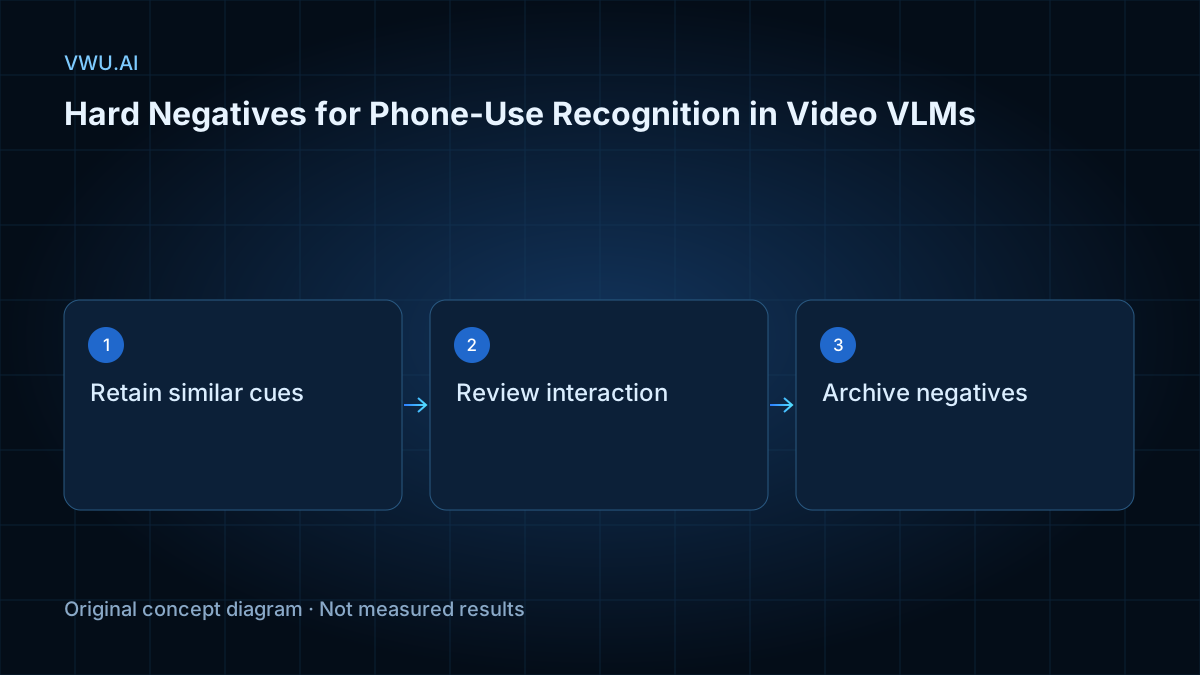
Design reviewable hard negatives for cabin video understanding by separating phone presence, actor identity and observable interaction instead of relying on visual shortcuts.
A phone appearing in cabin footage does not establish that the driver is using it. Hard negatives are useful when they retain a tempting visual cue while removing a specific piece of action evidence. For video understanding and vision-language models, define the target action before collecting pairs of examples. Adding more empty-handed driving clips alone may not address the confusion that matters.
This is a recommended data-design workflow. The examples below are conceptual and do not describe measured VWU.AI model results, customer deployments or a universal safety classification.
Separate object presence from action labels
Specify whether the task detects picking up a phone, holding a phone near an ear, interacting with a screen or a broader phone-related category. These tasks need different evidence. Also identify the actor: a passenger using a phone is not equivalent to the driver using one.
Record actor, object, action and observability separately. A stationary phone can be a positive example for object presence and a negative example for a particular hand-held action. If the relevant hand-object interaction is hidden, preserve an unobservable decision instead of automatically declaring the clip a hard negative. A missing view is not proof that an action did not occur.
Choose negatives close to the decision boundary
Useful candidate pairs include a visually similar small object versus an identifiable phone, a hand near the face without a visible phone versus a phone held near an ear, and passenger interaction versus driver interaction. Another comparison is a phone resting in a mount or on a seat versus direct manipulation by the driver.
These are sampling suggestions, not judgments about whether an activity is safe. Each pair requires sufficient visual evidence for the intended distinction. Avoid changing actor, viewpoint, illumination and background simultaneously if the goal is to isolate one confusing cue. Otherwise, an apparent improvement may reflect recognition of a different person or scene rather than the target action.
Preserve evidence across the clip
An individual frame may establish object presence while failing to establish an ongoing interaction. Keep a reviewable clip and record the exact frames supplied to the model. Distinguish seeing a phone, seeing hand-object contact and seeing observable interaction. Do not infer an unseen sequence from a single attractive screenshot.
Drive&Act frames cabin behavior as a fine-grained, multimodal and cross-view recognition problem. This is useful context for preserving action hierarchy and observation conditions. It does not supply a ready-made error guarantee for a different phone-use application.
Review the model's explanation as a separate output
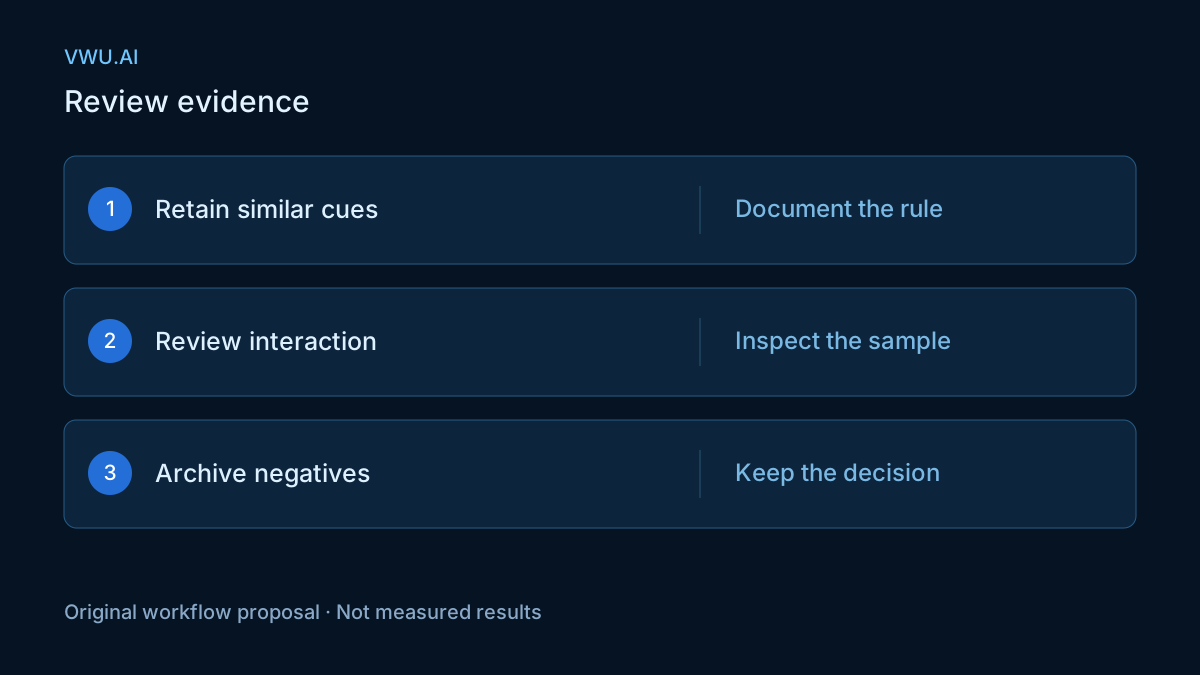
For a VLM, request an action label and a short statement of visible evidence. If it answers making a call because a phone is somewhere in the cabin, the reasoning has skipped the interaction requirement. Record this failure type independently from the final classification so that the next data revision targets the missing distinction.
The 2026 driver activity description study investigates natural-language supervision for fine-grained driver actions. It supports treating descriptions as their own evaluation task. It does not establish that a model's explanation is automatically faithful to the pixels. Review explanations against the actual input clip rather than rewarding convincing language alone.
Driver activity description research
Keep the challenge set separate from the base test
A hard-negative set intentionally increases the concentration of confusing examples. It should not be presented as the natural distribution of road activity. Maintain a base test that reflects the project's intended scope and a challenge set that diagnoses specific confusions. Report their results separately rather than combining them into an unexplained headline number.
For each revision, retain the error category, sample identifier, annotation evidence and decision. When failures become new training examples, preserve independent evaluation material that was not used to tune the system. Familiarity with a previously failed example is not evidence of generalization to every similar interaction.
Deliver decisions that another reviewer can reproduce
A useful package includes target-action definitions, positive and negative pairs, actor identifiers, object evidence, abstention rules, frame-sampling settings and adjudication notes. Pilot the instructions with independent annotators before expanding collection. If disagreements expose an undefined action category, repair the category rather than treating every disagreement as annotator error.
Driver distraction annotation guide
Driver monitoring training data
Editorial note and further reading
Prepared by the VWU.AI editorial team from public research and official documentation for training-data planning and procurement. The workflow is a recommendation, not a report of completed model tests or customer projects.