
Published 2026-11-06 · VWU.AI
Grounding Driver Gaze Zones for Vision-Language Models
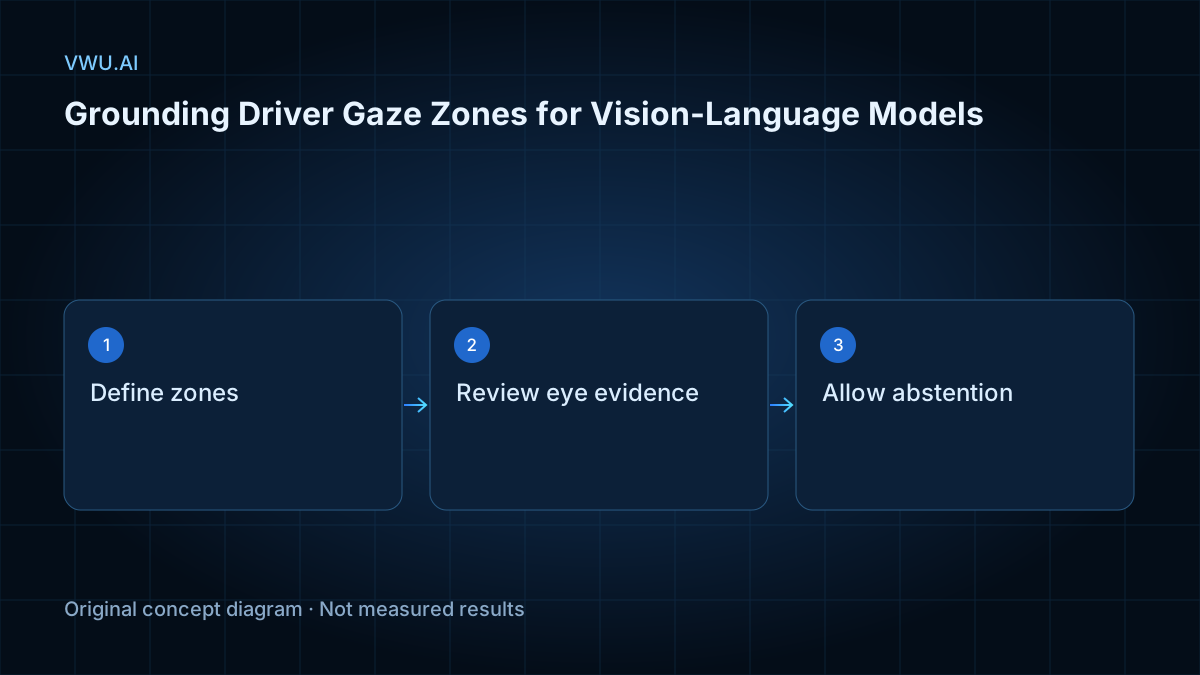
Define cabin gaze zones, directional conventions and abstention rules so VLM answers map to reviewable locations without confusing head pose with attention.
A vision-language model needs more than a plausible sentence to answer where a driver is looking. The evaluation needs a predefined region vocabulary and enough visible evidence to support a location. Deliver region definitions, evidence rules and abstention conditions together, then test whether different verbal answers consistently map to the same cabin region. The following is a recommended annotation workflow, not a validated universal gaze standard.
Define locations before collecting descriptions
Regions should correspond to inspectable locations in the target vehicle. Example regions might include the forward road, instrument area, center console and mirrors. These are illustrative choices rather than a taxonomy that applies unchanged to every cabin. Vehicle layout, driving side and camera placement can change their interpretation.
Give each region a stable identifier, names in both publication languages, a spatial description and boundary examples. A phrase such as looking left is ambiguous unless it specifies image coordinates, the driver's perspective or vehicle coordinates. Keep region identifiers stable across translations so that localization does not silently change the geometry.
Separate gaze, head orientation and inferred state
Head orientation can provide evidence, but it is not identical to eye direction. A valid region annotation also does not establish cognitive distraction, fatigue or attention quality on its own. Limit each label to the information supported by the recording rather than extending an observation into an unverified mental-state judgment.
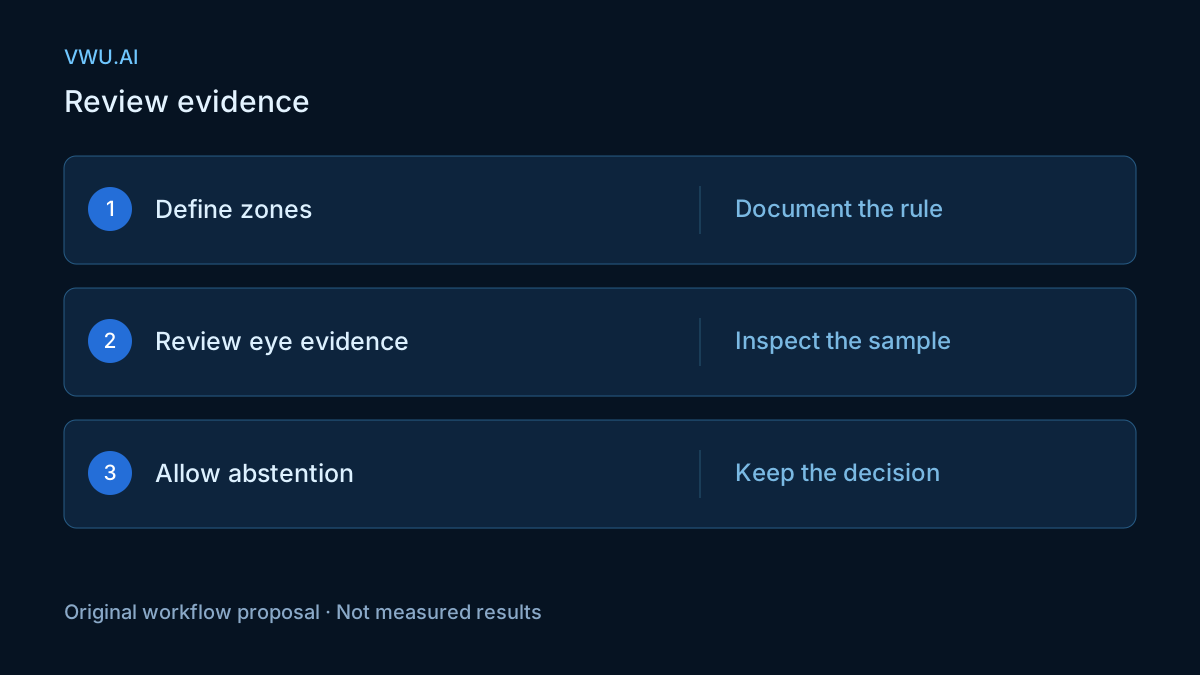
A practical response structure has three independent parts: a region identifier, a short evidence description and an observability decision. For example, a turned head with occluded eyes may support a head-orientation statement while leaving gaze unresolved. This is a rule example, not a measured model prediction. Keeping the distinction explicit prevents annotation shortcuts from becoming training targets.
Put occlusion into the instructions
SynDD2 describes distraction activities and gaze zones recorded in a stationary vehicle, including appearance conditions involving hats and sunglasses. This supports recording appearance conditions separately from the target region. It does not establish performance during all real-road conditions. Its use of the word synthetic should also not be interpreted as proof that the images were generated by a modern image model.
Annotators should distinguish missing eye evidence, an unresolvable destination and an ambiguous region boundary. A single other category loses those reasons. Preserve original decisions and adjudication notes so that a later revision of the region definitions can be applied transparently rather than silently rewriting the reference data.
Test constrained answers and grounded explanations
Ask for a permitted region identifier before a brief explanation. Check vocabulary validity first, region correctness second and evidence consistency third. Correct formatting is not a correct gaze estimate, and a fluent explanation cannot compensate for an incorrect location.
Use a fixed-question set alongside a controlled paraphrase set. Check whether a phrase change such as mirror area to rear-view mirror changes the answer when the visual evidence has not changed. Permit an explicit unobservable response. A prompt that forces a region in every case can turn missing evidence into a confident but unsupported label.
Keep research claims within their task
The 2026 driver activity description study treats fine-grained behavior descriptions as a dedicated vision-language task. It is useful context for task-specific evaluation, but activity-description results are not gaze-region accuracy. Nor do they replace project-specific instructions for human reference annotations.
Driver activity description research
Record region decisions, explanation correctness and uncertainty handling separately. A text-similarity score cannot capture every distinction: different wording can refer to the same location, while similar wording can point to opposite sides of a vehicle. Review examples of both patterns before selecting the final evaluation procedure.
Request a reviewable region package
A useful procurement package includes a cabin region diagram, vocabulary version, directional convention, occlusion rules, boundary examples and exact model-input configuration. Start with independent human annotation and investigate disagreements. If the disagreement comes from an undefined boundary, majority voting alone will not repair the specification.
Agree project-specific acceptance criteria before the final evaluation.
Driver and occupant monitoring training data
Driver distraction annotation guide
Editorial note and further reading
Prepared by the VWU.AI editorial team from public research and official documentation for training-data planning and procurement. The workflow is a recommendation, not a report of completed model tests or customer projects.