
Published 2026-11-18 · VWU.AI
DMS Data Pilot Acceptance: A Plan Before Batch Production
Build a reviewable DMS data pilot with agreed scope, sample selection, defect records, correction rules and separate checks for dataset conformance and model performance.

A DMS data pilot should answer a purchasing question: can this supplier deliver the agreed files, observable behaviors and annotations under the intended conditions? Define that question and the acceptance evidence before production. A visually convincing demonstration or one model score is not a complete acceptance plan.
This guide proposes a pilot worksheet and decision process. It does not prescribe a universal sample count, defect allowance or model threshold. Those choices depend on your task, risk, conditions and available evidence, and should be agreed explicitly.
Freeze a bounded pilot scope
Name the prediction task, camera setup, required behaviors and normal counterexamples. Specify accepted clip quantity and duration range, annotation types, output format and the expected source records. State what is outside scope: for example, a second camera view or labels that cannot be observed in the proposed framing.
Use stable identifiers for the brief, label rules and pilot batch. If the rule changes during review, keep the old version and record which samples require relabeling. Otherwise a later pass rate can silently mix different definitions.
Choose samples that can expose the intended failure modes
Ask for both ordinary examples and conditions likely to reveal a mismatch: partial occlusion, changes in light, actions near clip boundaries and visually similar non-target behavior. Make the selection reproducible by keeping the inventory and the selection rule. A hand-picked showcase can explain a concept, but it cannot establish the quality of an unseen batch.
Do not promise that a small pilot represents every future combination. Mark conditions that were not exercised and decide whether they need a second pilot, a restricted scope or explicit monitoring during the batch. Distinguish an absent test from a passed test.
Use a worksheet with evidence and responsibility
| Review area | Evidence to retain | Responsible decision |
|---|---|---|
| Files and packaging | File list, readable formats, durations and expected counts | Buyer confirms pipeline compatibility |
| Scenario content | Sample ID and timestamp showing the agreed behavior and conditions | Named reviewer checks the brief |
| Annotations | Rule version, visible reference evidence and export readback | Annotation owner resolves interpretation |
| Quality defects | Defect type, affected interval, impact and proposed correction | Both parties agree disposition |
| Rights and delivery | Agreed usage scope, source records and delivery restrictions | Project owner confirms permitted use |
A completed worksheet should let another reviewer locate the same evidence. “Looks wrong” is a useful initial observation, but not a sufficient correction request.
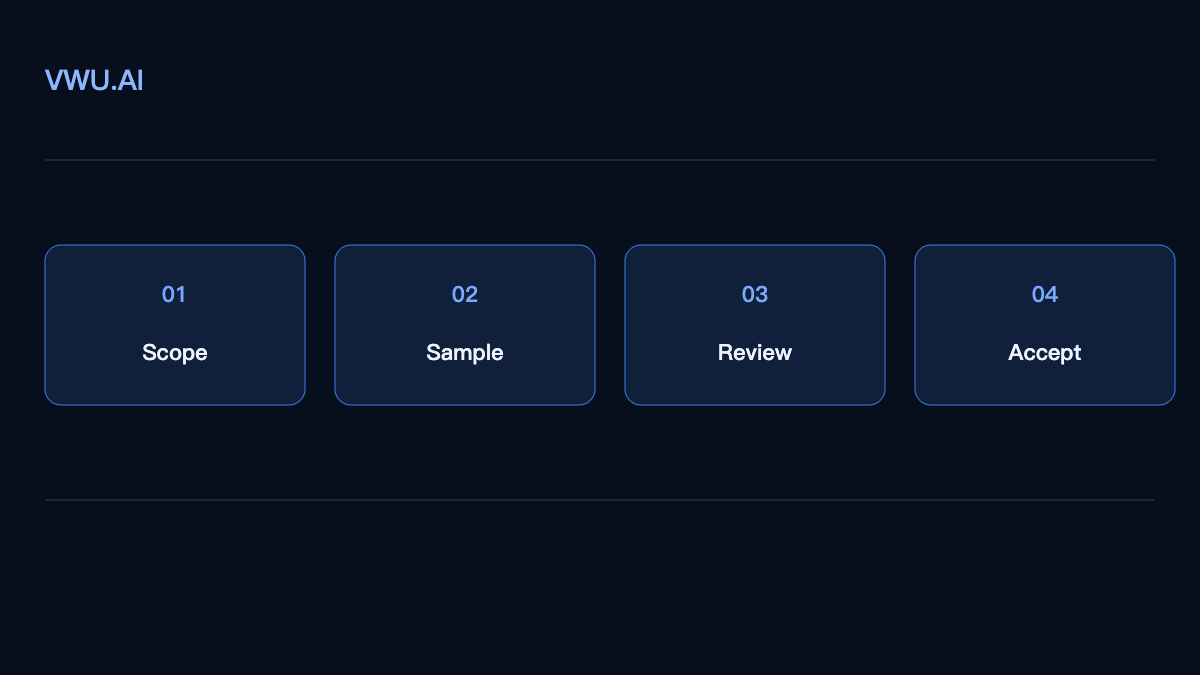
Original editorial workflow diagram; not measured results.
Separate conformance from model utility
Conformance asks whether the deliverables satisfy the specification. Model utility asks whether data helps a defined prediction task on an appropriate evaluation set. A conforming dataset may still be unhelpful for a particular model; a strong model score does not excuse missing files or incorrect labels.
If a model experiment is part of the pilot, agree the baseline, training configuration, evaluation population, metrics and decision rule beforehand. Keep related samples out of conflicting partitions. The scikit-learn grouped cross-validation documentation describes group-aware splitting for dependent samples. Applying the grouping principle does not itself establish deployment performance.
Record defects without inventing a tolerance
Create project-specific categories, such as an unreadable file, wrong behavior, unverifiable label or missing metadata. Separate a confirmed defect from a question about interpretation. For each issue, save the sample ID, time interval, expected rule, observed evidence and requested action. Avoid personal information in shared review exports.
For example, a hypothetical sample may show an action starting before the clip begins. If the brief requires a visible onset, record a scope failure; if truncated events are allowed, record the agreed boundary flag. The same footage can receive different dispositions under different written rules. See the temporal-boundary guide.
Agree corrections and the batch decision
Before work begins, state who fixes which defects, how replacements are identified, whether corrected samples are rechecked and which changes require a revised quote. Preserve original and replacement identifiers instead of overwriting the evidence history.
Close the pilot with one of three documented decisions: proceed under the approved rules, revise and rerun specified checks, or stop because the scope is not feasible. List unresolved conditions and the batch checks that remain necessary. A pilot sign-off should name the approver, rule version and accepted inventory, not merely an email saying “OK.”
Use the annotation quality checklist for label checks and the delivery integrity guide for packaging. Discuss a scoped pilot with VWU.AI before committing to a batch.
Sources and scope
Sources were checked on November 10, 2026. The worksheet and decisions are editorial procurement recommendations, not an industry certification or a promise of a particular outcome. No customer experiment or universal acceptance threshold is reported. Corrections: chan@vwu.ai.
Image credit
Backlit computer keyboard (40623300100) — freestocks.org from Olsztyn, Poland. CC0 1.0.
Original image and attribution
Reference photo for context. Resized and cropped for display; no endorsement is implied.