
Published 2026-11-20 · VWU.AI
Synthetic Video Quality: A Temporal Consistency Review
Review synthetic cabin video for identity drift, object continuity, action validity and timing, using reproducible defect records rather than appearance alone.

Review a synthetic training clip as a sequence, not a collection of attractive frames. Check whether the same people and objects persist, whether the intended action remains interpretable and whether changes over time match the agreed task. A realistic still image cannot establish those properties.
This guide proposes a content review for synthetic cabin video. It separates visual defects from label problems and from downstream model evaluation. Passing the review does not prove that a clip improves a model or reproduces a real sensor.
Define what must remain consistent
Start with the task brief. Identify the actor, relevant objects, observable action and scene conditions. Decide which changes are intentional: a hand may move, a phone may enter the frame and a face may become occluded. Consistency does not mean that nothing changes; it means that changes remain interpretable under the scenario.
Record relevant camera behavior as well. If the brief calls for a fixed view, an unexpected cut or camera jump is a conformance issue. If movement is allowed, specify what must still be observable. Do not impose a generic “no motion” rule on a task that requires motion.
Review at normal speed, then inspect the evidence
First watch the entire clip at normal playback speed, with enough context to understand the action. Then inspect suspicious intervals and neighboring frames. Record both the displayed time and the frame-index convention used by the reader. If the file has variable frame timing, do not assume that multiplying time by a nominal frame rate identifies the exact frame.
Retain the source file, reader version, review-rule version and defect record. A screenshot can illustrate a problem, but adjacent frames or the interval are often needed to explain a temporal discontinuity. Do not detach a still image from the sequence and treat it as sufficient proof.
Check four dimensions separately
| Dimension | Question to ask | Example of an issue to investigate |
|---|---|---|
| Actor identity and anatomy | Does the actor remain recognizable and physically interpretable? | A hand or face changes structure during the target action |
| Object continuity | Can the relevant object be followed through visible motion and occlusion? | A phone disappears without an interpretable exit or occlusion |
| Action validity | Does the observed motion actually express the requested behavior? | An object is near the ear but no phone-to-ear interaction is visible |
| Scene and time continuity | Are viewpoint, ordering and environmental changes consistent with the brief? | An unintended cut changes the actor or resets the action |
Treat these as review questions, not automatic rejection rules. A temporary disappearance behind a visible occluder is different from an unexplained disappearance. Record uncertainty when the evidence cannot distinguish them.
Write a defect record another reviewer can reproduce
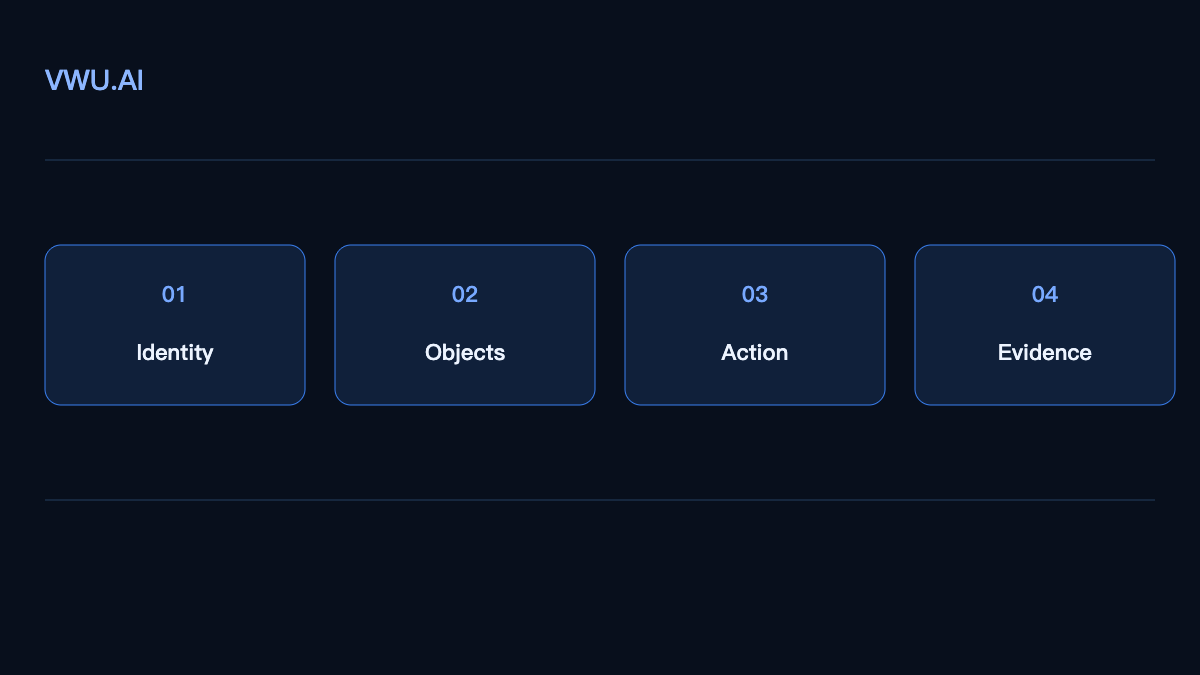
Original editorial workflow diagram; not measured results.
Consider a hypothetical six-second clip. At 2.2 seconds a driver holds a phone; at 2.4 seconds the visible phone becomes a different-shaped object without leaving the frame. The reviewer records an object-continuity concern over that interval, retains neighboring frames and cites the brief requiring the same phone throughout the action. Those times are illustrative, not a measurement from VWU.AI production.
Record clip ID, file version, interval, defect category, observable evidence, related requirement, reviewer and disposition. Separate “confirmed mismatch” from “needs a second review.” Avoid adding labels for emotions, intentions or health states that cannot be established from the visible evidence.
Keep automated screening in its proper role
NVIDIA’s Physical Plausibility Evaluator model card describes a video acceptability classifier and task-specific calibration. Such a tool may support a review workflow, but its score is not a universal acceptance standard for your cabin task.
If you use automated screening, record the tool and model version, input preparation, decision threshold and the human-reviewed cases used to examine its behavior. Inspect disagreements and relevant conditions. Do not let a screening score silently replace the written action definition or conceal unreviewed clips. No automated tool was run to produce results for this article.
Resolve content defects before trusting annotations
A precise timestamp does not repair an invalid action. Where content is ambiguous, keep the uncertainty or reject the sample under the agreed rule rather than forcing a confident label. After correction or regeneration, create a new file version and recheck the affected sequence; an edit may change timing and invalidate older annotations.
The temporal annotation guide covers label boundaries, while the manifest guide covers traceable file changes. Use both after a clip has been replaced.
Make a scoped batch decision
Summarize confirmed defects, unresolved questions, corrected files and conditions not reviewed. Agree what is acceptable for the intended use and what requires correction. Keep model usefulness as a separate experiment with appropriate held-out data; the real-versus-synthetic evaluation guide describes that distinction.
Discuss synthetic cabin-video requirements with VWU.AI. Bring the target action and review rules, not only a preferred visual style.
Sources and scope
The source was checked on November 10, 2026. The review matrix and example are editorial recommendations, not measured results, a model endorsement or a guarantee of training performance. Corrections: chan@vwu.ai.
Image credit
Light shining through a camera lens — AlbertGy. BY 4.0.
Original image and attribution
Reference photo for context. Resized and cropped for display; no endorsement is implied.